
One of the most common mistakes I see growth-stage companies make is borrowing the wrong playbook. There is always some ‘innovative’ idea being chased down every week.
They see a B2C brand crush it with influencer marketing and try to replicate it, except they sell API infrastructure to enterprise clients. Or they watch a B2B company build an SDR-heavy outbound motion and copy it, except their product is a consumer app that lives and dies by organic word-of-mouth.
The model mismatch costs time, money, and momentum. And it happens because teams are picking tactics before they’ve clearly defined their business model and what that model actually demands from a growth perspective.
This piece is a practical breakdown of the major business model types – B2B, B2C, B2B2C, D2C, and a few others worth knowing and what each one means for how you build your growth motion.
Why Your Business Model Is Your Growth Strategy
Before we get into the taxonomy, I need you to first understand that your business model is not just a description of who you sell to, it’s a description of the relationship structure between you, your customer, and their end user and those relationships determine everything about how growth works.
They determine your sales cycle length. Your content strategy. Your pricing model. Your CAC benchmarks. The channels that will and won’t work for you. The metrics that matter most.
Getting this wrong doesn’t only mean you’re running the wrong campaigns. It means your entire growth architecture is misaligned with how your business actually creates value. That’s a much deeper problem than bad ads.
Your business model isn’t just who you sell to. It’s the blueprint for how growth is supposed to work.
With that framing established, let’s walk through each model.
B2B: Business-to-Business
What it is
In a B2B model, you sell products or services to other businesses. Your buyer is a company, and your decision-maker is typically a professional – a CFO, a CTO, a Head of Operations, a Procurement lead, someone who is spending company money and is accountable for the outcome.
Examples: Salesforce, HubSpot, Flutterwave’s API suite, a management consulting firm, a B2B SaaS tool for HR teams.
How B2B growth typically works
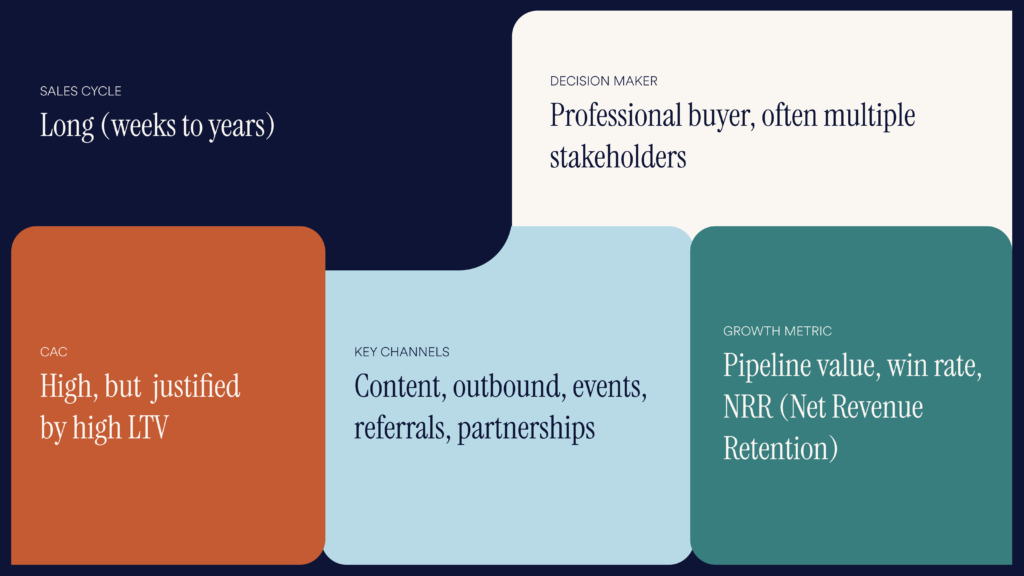
B2B marketing strategy is relationship-dense and trust-intensive. The sales cycle is long- weeks to months, sometimes years for enterprise deals. The decision involves multiple stakeholders. And the contract value is typically high, which means the cost of a lost deal is significant.
This shapes your growth motion in specific ways:
- Content is your top-of-funnel. Thought leadership, research reports, case studies, and frameworks position you as credible before a prospect is ready to buy. In B2B, people buy from who they trust, and trust is built over time, through consistent, valuable output.
- Outbound is a real channel. Cold outreach done well works in B2B because you can identify and target specific decision-makers by role, company size, and industry. The precision is the advantage.
- Community and events matter. Industry conferences, roundtables, webinars, and peer communities are where B2B relationships are built. Showing up consistently in the right rooms is a growth strategy.
- Referrals and account expansion are your highest-leverage plays. A happy B2B customer who refers you to three others or expands their contract by 40% is worth more than almost any paid channel.
The metric that governs B2B growth is pipeline health, specifically, pipeline quality and velocity. You want the right deals moving fast enough.
How successful each of these growth motions become for your business is dependent on the type of resources (team, budget, structure) that you have put together. Whichever isn’t well done will fall through.
B2C: Business-to-Consumer
What it is
In a B2C model, you sell directly to individual end consumers. The buyer and the user are the same person. Decisions are made quickly, often emotionally, and the relationship is frequently transactional.
Examples: Netflix, a fashion e-commerce brand, a consumer fintech app like PiggyVest, a food delivery platform, a retail beauty brand.
How B2C growth works
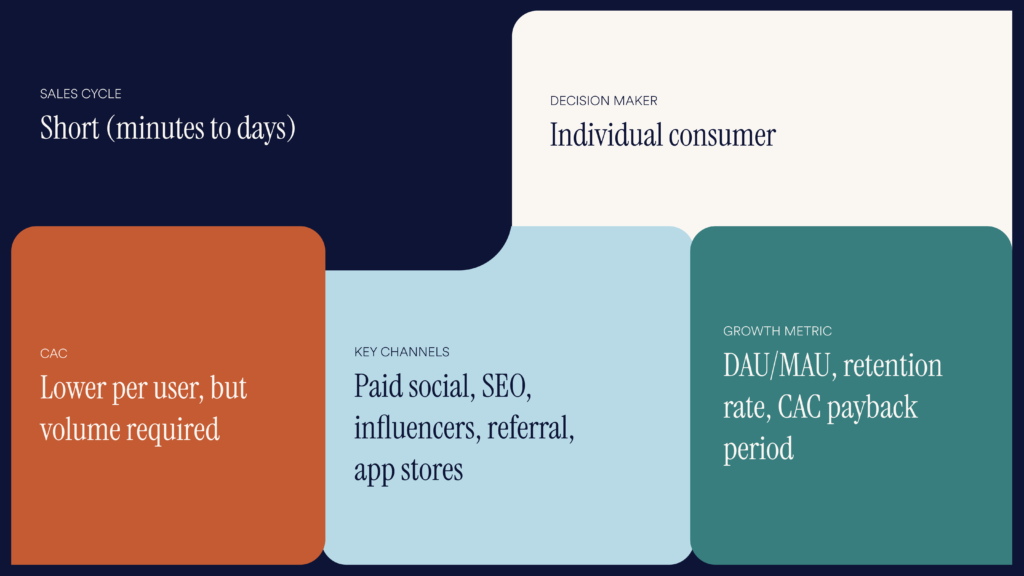
B2C growth is a volume game. Because individual transaction values are typically lower, you need to acquire and retain a large number of users to generate meaningful revenue. This makes unit economics, particularly CAC vs. LTV the governing framework.
The B2C growth motion looks different in important ways:
- Brand and emotion drive decisions. Consumers don’t run ROI calculations before buying a pair of trainers or downloading an app. They respond to identity, aspiration, social proof, and convenience. Your brand is doing a lot of the selling.
- Paid acquisition is table stakes but also a trap. Meta Ads, Google, TikTok, these platforms give you access to scale fast. But if your unit economics don’t work, you are paying to grow a loss. Many B2C companies have learned this the hard way.
- Retention is the real game. Acquiring a consumer is expensive. Keeping them is where margin is made. Loyalty programs, personalization, notification strategy, building a valuable community and product habit-formation are B2C retention’s primary tools.
- Influencer and creator channels are structurally effective. In B2C, social proof from trusted voices shortcuts the consideration phase dramatically. This isn’t a trend and should not be treated as such as it’s a structural fit between the model and the channel.
- Virality is more achievable here. Because consumers are connected to other consumers through social networks, the conditions for organic viral loops are naturally stronger in B2C than B2B.
The metric that governs B2C growth is DAU/MAU (daily/monthly active users), retention curves, and payback period on CAC.
B2B2C: Business-to-Business-to-Consumer
What it is
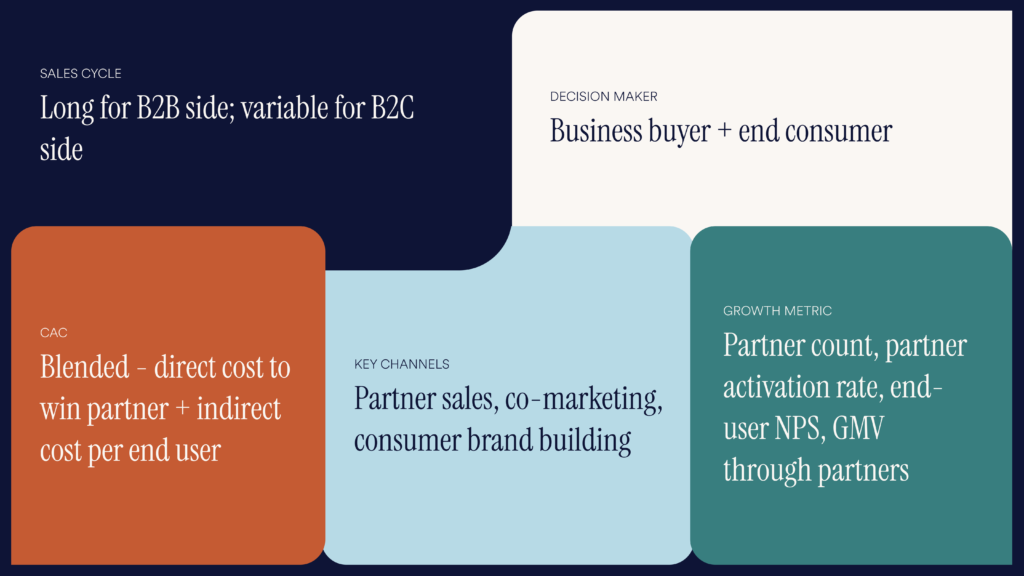
B2B2C is the model that most people misunderstand. In a B2B2C go-to-market structure, you sell your product to a business (B2B), but the end user of that product is a consumer (B2C). You have two customers: the business partner who pays you, and the end consumer who uses what you’ve built.
Examples: Stripe powering payments for e-commerce brands (the brands are clients, their shoppers are end users), a white-label fintech infrastructure provider, a health insurance company that sells to employers whose employees are the beneficiaries, an EdTech platform that licenses its content to schools but teaches students.
How B2B2C growth works
This is where growth strategy gets really complex and genuinely interesting. Because you’re managing two distinct relationships simultaneously, and they have different needs, different metrics, and different success conditions.
Your B2B motion needs to be sharp. You have to sell the business on the value of integrating or distributing your product which means ROI clarity, integration ease, and commercial terms that make sense for their model.
Your B2C motion needs to be real, even if it’s not your primary channel. Because demand and then quality of the end-user experience determines whether your business partner comes onboard, continues to use you, expands the relationship, or churns. If the end consumer has a bad experience with your product through a partner, you lose the partner.
- Partner success is your growth lever. In B2B2C, your distribution is your partners. The more successfully they deploy and activate your product with their consumers, the more your reach grows. Partner enablement – onboarding, co-marketing, training is not an afterthought, it’s a growth function.
- Consumer experience drives B2B retention. Never forget this. The reason a business stays with you is because their customers are happy with what you power. Build for the end user even when they’re not paying you directly.
- Brand awareness at the consumer level creates pull. If end consumers are aware of and trust your underlying product (think ‘Powered by Stripe’), they start requesting it from other businesses they interact with. This is a powerful secondary acquisition loop.
- Attribution is hard. In B2B2C, figuring out what’s driving growth is genuinely complex. Which partner is performing? Which consumer segment is activating? Which integration is driving end-user retention? You need layered analytics to see this clearly.
In B2B2C, you’re not only acquiring customers, you’re acquiring distribution channels that come with their own customers attached.
D2C: Direct-to-Consumer
What it is
D2C (Direct-to-Consumer) is a model where a brand manufactures or creates a product and sells it directly to end consumers cutting out the retailer, distributor, or middleman. It’s a subset of B2C, but the ‘direct’ part is doing significant strategic work.
Examples: Warby Parker, Glossier, a Nigerian skincare brand who manufactures their own skincare and sells through its own website and Instagram, a food brand that ships directly from its kitchen to the customer’s door.
How D2C growth works
The defining characteristic of D2C growth is data ownership. Because you own the relationship with the customer, not through a retailer or a marketplace, you own the data, the conversation, and the repeat-purchase relationship.
This changes your growth calculus in important ways:
- First-party data is a moat. You know who your customers are, what they buy, how often they come back, and what messaging resonates. This is increasingly rare and valuable in a privacy-first advertising landscape.
- Owned channels are your compound interest. Email lists, WhatsApp communities, Instagram followings, these are assets that grow over time and cost less to activate than paid channels. D2C brands that build owned audiences early have a structural cost advantage later.
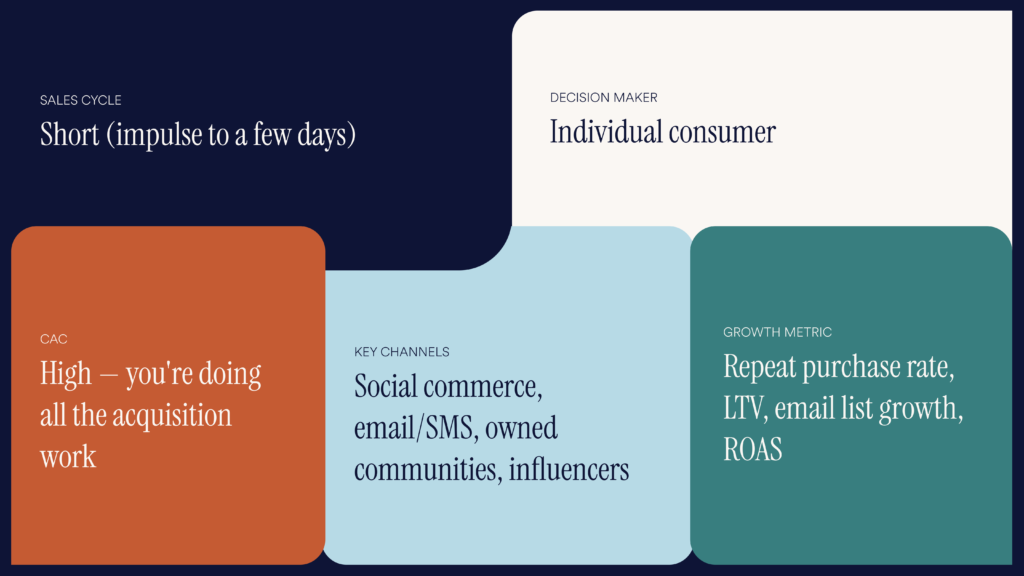
- The economics only work if retention is strong. D2C typically has high customer acquisition costs because you’re doing all the marketing yourself. The model is only viable if customers come back, ideally on subscription or high purchase frequency.
- Social commerce is native to D2C. Instagram Shops, TikTok Shop, live selling, WhatsApp ordering, these are D2C-native channels. They collapse the distance between discovery and purchase, which is a huge advantage.
Where D2C companies often go wrong is over-investing in top-of-funnel paid acquisition before fixing retention. If your repeat purchase rate is low, more acquisition is not the answer, it’s a more expensive version of the same problem.
Other Models Worth Knowing
The B2B/B2C/B2B2C/D2C framework covers most companies, but there are a few other business model types worth having in your vocabulary particularly as markets in Africa and emerging economies evolve.
C2C: Consumer-to-Consumer
Platforms that facilitate transactions between individual consumers. Jiji, eBay, Airbnb (in its original form), peer-to-peer lending platforms. The company doesn’t sell the product, it provides the infrastructure for consumers to transact with each other. Growth here is marketplace dynamics: you need supply and demand to scale simultaneously, which is one of the hardest cold-start problems in tech.
B2G: Business-to-Government
Selling to government entities, ministries, or parastatal bodies. The sales cycle is the longest of any model- procurement processes, tenders, compliance requirements, and political considerations all add friction. But contract values are large and relationships are sticky. Companies in infrastructure, health tech, civic tech, and enterprise software often have a meaningful B2G component even if it’s not their primary model.
B2D: Business-to-Developer
A model that targets developers as the primary buyer and influencer. Twilio, Stripe, and AWS built empires on this. Developers adopt the product, fall in love with the developer experience (DX), and bring it into the companies they work for. The growth motion is bottoms-up: individual adoption that converts to enterprise contracts. This is technically a B2B model, but the persona, the content strategy, the channel mix, and the product philosophy are distinct enough to treat it separately.
Marketplace / Platform Models
Platforms that connect two or more distinct user groups and take a margin on transactions between them. Paystack connecting businesses and their customers. A freight marketplace connecting shippers and logistics providers. Growth in platform models is fundamentally about network effects; the platform becomes more valuable to each participant as more participants join. This creates compounding growth, but also the hardest cold-start challenge in business.
So Which Model Is Yours?
Many companies are operating across more than one model simultaneously and that’s fine, as long as you’re clear about which model governs each revenue stream and you’re not confusing their growth motions.
A fintech that has a consumer wallet (B2C) and an API suite for developers (B2D/B2B) needs two distinct growth strategies. The metrics are different. The content is different. The channels are different. The sales motion is different. Treating them as one is a recipe for mediocre performance across both.
Ask yourself three clarifying questions:
- Who is paying? This tells you your customer.
- Who is using? This tells you your end user. In many models, these are the same person. In B2B2C, they’re not.
- Who is deciding? This tells you where your marketing and sales energy should be concentrated.
Once you’re clear on those three, the growth motion becomes more obvious. Not easy, obvious. There’s a difference.
Clarity on your business model doesn’t simplify your growth work. It focuses it. And focused execution beats scattered effort every time.
Matching Growth Strategy to Business Model: A Quick Reference
Let me make this as practical as possible. Here’s how I think about the fit between business model and growth strategy:
If you’re B2B:
Invest in thought leadership and content that builds credibility over time. Build outbound capability with tight ICP targeting. Create a referral motion early. Measure pipeline quality, not just volume. Win rates and NRR are your north stars.
If you’re B2C:
Get obsessed with retention before you scale acquisition. Understand your LTV:CAC ratio at cohort level, not just average. Build owned audiences (email, community) as a hedge against rising paid media costs. Use influencers strategically, not randomly.
If you’re B2B2C:
Treat partner success as a growth function, not an afterthought. Invest in co-marketing with your top partners. Monitor end-user experience metrics even though end users aren’t directly paying you. Build brand awareness at the consumer level so partners feel the pull to work with you.
If you’re D2C:
Own the customer relationship fiercely. Build your first-party data infrastructure early. Prioritize repeat purchase rate above almost everything else. Use social commerce natively, don’t treat it as an afterthought to your website.
If you’re a marketplace:
Solve the cold-start problem first, don’t try to scale before you’ve achieved local density. Understand which side of the market (supply or demand) is the constraint, and solve that side with focus. Network effects don’t kick in automatically; you have to engineer the conditions for them.
Business model clarity is the first act of growth strategy. Without it, you’re making creative decisions on a foundation that hasn’t been properly laid.