
In Part 1 of this series, I laid out the universal partnership-led growth Africa activation framework: a 5-phase playbook that takes a signed partnership from announcement to revenue within 6 to 12 months. That framework applies to any market, any sector, and any partnership structure, I recommend starting there to better understand this part as those problems exist everywhere partnerships are treated as a business development activity rather than a growth channel.
This second part is about why that framework matters more in African and EMEA markets because in these markets, partnerships are not one growth channel among many, they are often the primary growth channel. The consequences of activating them well are proportionally larger. And the consequences of activating them poorly are proportionally more damaging.
Why Partnership-Led Growth Is the Primary Channel for Africa Market Entry
I have written extensively in my Africa market entry series which will be published in a few days about the trust dynamics that shape customer acquisition on the continent. Within the African context, the trust funnel is longer, the relational requirements are higher as the customer needs to know that a product is real, that it will still exist in six months, and that someone they trust has vouched for it before they will convert.
These trust dynamics are the operating system of commerce in most African markets and they fundamentally change the relative effectiveness of different growth channels. Paid acquisition can generate clicks, but clicks and even conversion but do not produce trust. Content marketing can build awareness, but awareness without endorsement converts really slowly. Outbound sales can generate conversations, but conversations without relational credibility close at a fraction of the rate they would in a developed market.
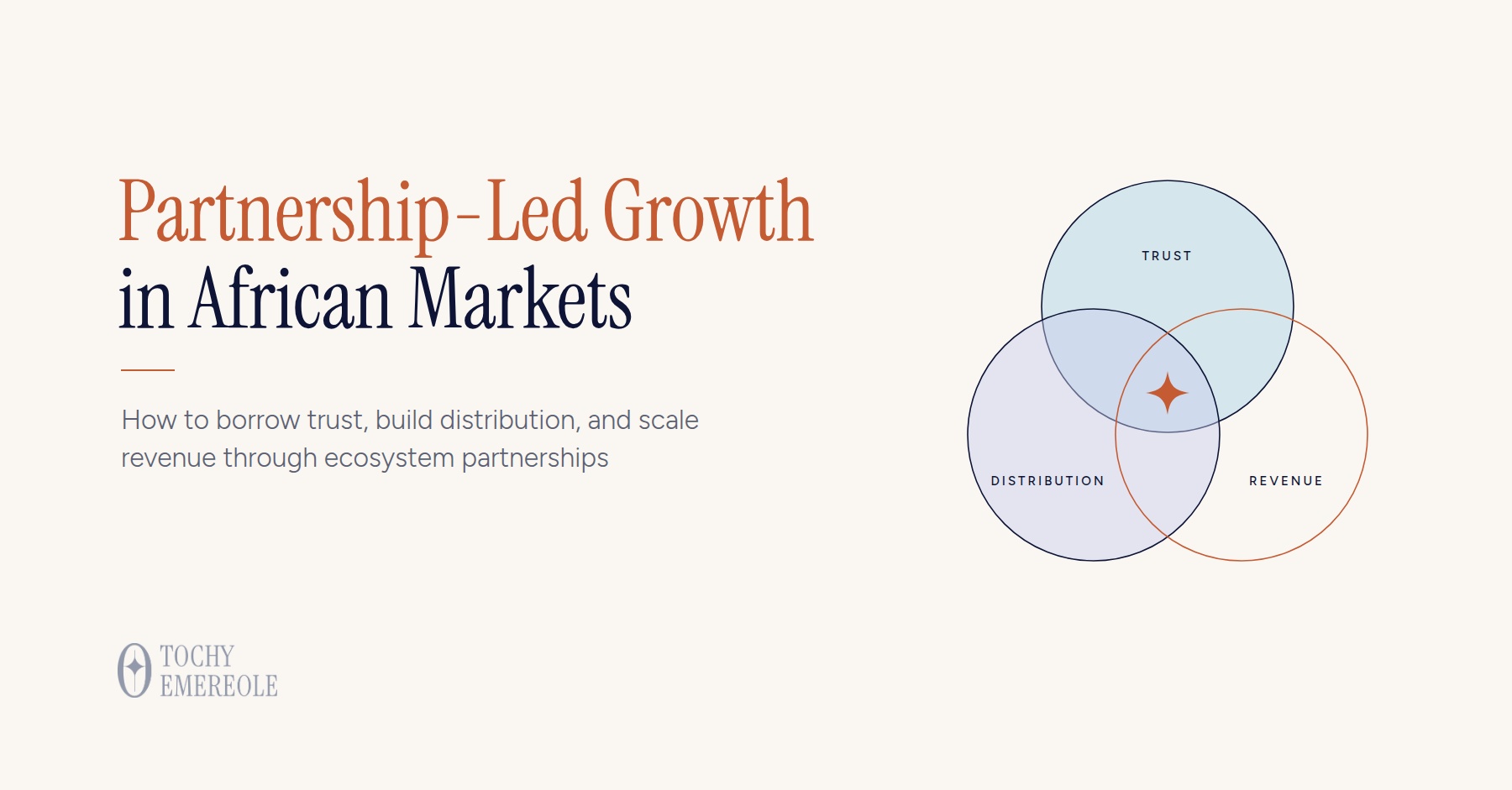
Partnership-led growth shortcuts all of these constraints by borrowing the trust that your partner has already built with their audience. When a respected community recommends your product, that recommendation carries the weight of years of credibility that the community has earned with its members. When a trusted fintech platform integrates with your service, the integration itself is a trust signal: this company is legitimate enough for us to connect our systems and our customers to them. When a respected industry voice stakes their personal reputation on endorsing your product, that endorsement moves the trust needle more in a single moment than months of paid media.
This is why partnership-led growth is not only effective in African markets, it is structurally advantaged. The trust transfer that partnerships provide is more valuable here than in any other market context, because the trust gap that new entrants must cross is wider and the alternative methods of crossing it are slower and more expensive.
The Fragility of Borrowed Trust in Emerging Markets
There is a critical corollary to the power of trust transfer in African markets: borrowed trust is exponentially more fragile than earned trust. If you announce a partnership with a trusted community and then fail to activate it, fail to deliver value to the community’s members, fail to follow through on the promises your partnership deck made, you have not just wasted a partnership opportunity. You have damaged the partner’s trust with their own audience.
And in African business ecosystems, where networks are tighter and reputation travels faster than any press release, that damage radiates outward. The community lead tells other community leads. The partner tells other potential partners. The ecosystem forms a collective judgment: this company announces partnerships and then disappears. Good luck closing your next partnership after that judgment has been made.
The community lead whose frustration sparked Part 1 of this series was not expressing an individual annoyance, he was expressing an ecosystem-wide sentiment because he has been burned before, his peers have been burned before, the entire ecosystem of community leaders, industry voices, and potential distribution partners has developed a healthy skepticism toward partnership proposals because too many companies have taken trust and delivered nothing in return.
This is why the activation framework from Part 1 is not just a revenue strategy in African markets, it is a reputation strategy. The companies that announce and disappear build a reputation that makes the ecosystem close its doors to collaboration.
Partnership Structures That Drive Emerging Market Growth in Africa
Not all partnerships are created equal, and in African markets, certain partnership structures consistently outperform others for Sub-Saharan expansion. The right structure depends on your product, your target segment, and the specific trust and distribution dynamics of the market you are entering. Based on my experience as a fractional CMO for Africa-focused companies, here are the three structures that generate the most value.
- Community Partnerships: The Highest-Leverage Play for Trust Transfer
Professional communities, industry associations, alumni networks, and trade groups are among the highest-leverage partnership targets in African markets. They hold concentrated, high-trust audiences that are almost impossible to reach through conventional marketing channels with the same level of credibility.
The reason community partnerships are so powerful for Africa market entry is structural. In markets where institutional trust is lower, community trust fills the gap. People trust their professional community, they trust the recommendations that come through community channels, they trust products and services that their community has vetted. A recommendation from a trusted community carries more conversion power than any amount of paid advertising because it comes with the implicit endorsement of a group the individual has chosen to belong to.
The activation playbook for community partnerships. The non-negotiable principle is value-first. The partnership must make membership in the community more valuable, not less. This means exclusive content that genuinely serves community members, not thinly disguised sales collateral; member-only offers that provide real economic value and not token discounts, educational events that address the community’s actual professional challenges, not product demonstrations masquerading as webinars, tangible resources, tools, and frameworks that community members can use immediately in their work.
The moment the community’s members perceive the partnership as extractive, taking attention and data without delivering proportional value, the partnership loses its value and over time, it’s power. Worse, it damages the community leader’s credibility with their members, which means the partnership will be terminated and the community lead will warn their peers. In African ecosystems where community leaders talk to each other regularly, one extractive partnership can close doors across multiple communities.
Applying the Part 1 framework
Phase 1 planning for community partnerships must include a detailed value delivery plan that the community leader reviews and approves before announcement.
Phase 2 launch should include a member-facing resource that is immediately available.
Phase 3 activation should prioritise content co-creation that showcases community member expertise, not just the partner’s product.
Phase 4 optimisation should be measured by community engagement metrics, member satisfaction surveys, and tracked conversion, not just pipeline generated.
Distribution Partnerships With Telcos, Banks, and Established Platforms
In African markets where trust is anchored to institutional relationships, partnerships with banks, telecommunications companies, and established digital platforms provide both distribution access and trust transfer at scale. These are the partnerships that can transform your Africa market entry from a slow build into an accelerated launch, because they give you access to millions of existing customers through a channel those customers already trust.
For African fintech marketing specifically, distribution partnerships with banks and mobile money platforms are often the single most important growth decision a company makes. An M-Pesa integration in Kenya or a partnership with a major Nigerian bank does not just provide a payment channel. It provides a trust signal, a distribution channel, and a customer acquisition engine simultaneously.
The reality of institutional partnerships. These partnerships are complex to negotiate, often requiring months of legal, compliance, and technical discussions. They are slow to activate, because institutional partners have their own governance processes and marketing approval cycles and they require dedicated product and engineering resources for integration, which means they compete with your product roadmap for development capacity. None of this should discourage you, instead, it should calibrate your expectations and your resource allocation.
Applying the Part 1 framework
Phase 1 for institutional partnerships often extends to 4-8 weeks rather than 2, because the pre-activation planning must account for the partner’s internal processes.
Phase 2 launch requires co-branded customer communication that leverages the institutional partner’s brand credibility, usually created jointly with the partner’s marketing team.
Phase 3 activation should include joint go-to-market planning that aligns with the partner’s own product and marketing calendar.
Phase 4 optimization should focus on integration depth: the deeper the technical and operational integration, the higher the switching cost for both parties and the more durable the partnership’s revenue contribution.
Influencer and Thought Leader Partnerships: Trust Depth Over Reach
In African markets, influencer partnerships operate on fundamentally different dynamics than in developed markets. The value is not in follower counts, it is in trust depth. A respected industry professional with 5,000 genuine followers who recommends your product will outperform a social media celebrity with 500,000 followers who posts a generic endorsement, because the trust infrastructure of African markets means that the source of the recommendation matters more than the reach of the recommendation.
The people who move markets in African business ecosystems are often not the people with the largest social media followings. They are the community leaders, the industry veterans, the professionals whose opinions carry weight because they have earned credibility through years of work, not through content creation. Identifying these people, building genuine relationships with them, and structuring partnerships that align their credibility with your product is one of the most effective emerging market growth strategies available.
Applying the Part 1 framework: The activation playbook for influencer partnerships must be built entirely around authenticity. Give the influencer access to your product. Let them experience it deeply, including the flaws and let their recommendation emerge from real conviction rather than scripted endorsement. In African markets, audiences can detect inauthenticity immediately, and an influencer who is perceived as selling out their credibility for a partnership fee loses the very trust that made the partnership valuable in the first place. Phase 3 co-created content should position the influencer as an expert sharing their genuine assessment, not as a spokesperson reading a brief.
Connecting Every Partnership to the Bottom Line
The most common objection I hear from leadership teams about investing more in partnership-led growth in African markets is that the ROI is hard to measure. This objection is valid only if you have not built the measurement infrastructure. With the right tracking and attribution, partnership ROI is not just measurable, it is often clearer than the ROI of other growth channels because the conversion paths are more defined and the audiences are more targeted.
Partnership- led growth in Africa
Attribution in African markets requires adapting the standard digital attribution models for an environment where much of the trust-building and decision-making happens offline, in WhatsApp conversations, through agent interactions, and in community discussions that your analytics platform cannot see.
First-touch partnership attribution. Track the first interaction that a customer had with your brand through a partnership channel. A click on a partner referral link, attendance at a co-hosted event, or redemption of a partner-exclusive offer. First-touch attribution tells you which partnerships are most effective at generating new audience exposure and is the simplest metric to instrument.
Assisted partnership attribution. Track every touchpoint that involved a partnership channel in the customer’s journey, even if the partnership was not the first or last touch. This is critical in African markets because partnerships often function as trust-building mid-funnel touchpoints rather than first-touch discovery channels. A customer might discover you through organic search, but convert because a trusted partner vouched for you in a community WhatsApp group. Assisted attribution captures this reality.
Qualitative attribution. In African markets, you must supplement digital attribution with qualitative signal tracking. Ask new customers how they heard about you, not just on a form where they will select ‘Google’ regardless, but in actual onboarding conversations where they will tell you the real story: ‘The community lead mentioned you at the last meetup,’ ‘I saw the partnership announcement on LinkedIn and then asked my colleague about you,’ ‘The agent at my local branch told me about it.’ These qualitative attribution signals, tracked systematically, give you a far more accurate picture of partnership-driven growth than any digital attribution platform can provide alone.
Revenue attribution. Attribute revenue to the partnership that sourced or significantly influenced the customer relationship. This requires the tracked conversion paths described in the Part 1 activation framework: unique URLs, discount codes, referral identifiers, and CRM tagging that flags partnership-sourced opportunities. The revenue attribution must flow all the way through the funnel: from initial lead to closed deal to actual revenue recognised. Pipeline is not revenue, opportunities are not revenue, only closed, recognised revenue counts for partnership ROI.
The Metrics That Prove Partnership-Led Growth In Africa Is Valuable
Partnership-sourced pipeline. The total value of sales pipeline generated through partnership channels. This is the leading indicator that tells you the partnership is producing commercial opportunities.
Partnership-sourced revenue. The actual closed revenue attributable to partnership channels. This is the number that connects partnerships to the bottom line and justifies continued investment.
Cost per acquisition through partnerships versus other channels. What does it cost to acquire a customer through a partnership channel versus paid acquisition, content marketing, or outbound sales? Include the partnership team’s time, the co-marketing investment, and any partner incentives in the numerator. In my experience across EMEA markets, the CPA through well-activated partnerships is consistently 40 to 60 percent lower than through paid acquisition because the trust transfer accelerates conversion and reduces the marketing touches required.
Lifetime value of partnership-sourced customers. Do customers who come through partnerships retain better, spend more, or have higher NPS than customers from other channels? In my experience as a growth strategy consultant for multinationals, the answer across EMEA markets is almost always yes. Partnership-sourced customers arrive with higher confidence and lower buyer’s remorse because the trust transfer from the partnership means they have already been pre-sold on your credibility. This LTV premium is one of the strongest arguments for investing in partnership-led growth.
Partner satisfaction and ecosystem reputation. Are your partners satisfied with the partnership? Would they renew it? Would they expand it? Are they actively recommending you to their peers in the ecosystem? Partner satisfaction is a leading indicator of partnership sustainability. It is also, as the community lead’s frustration taught me, the indicator that most organisations fail to track until the partner has already disengaged. In African business ecosystems, your partner satisfaction score is effectively your ecosystem reputation score, and your ecosystem reputation determines how easy or difficult every future partnership will be to close.
The Operating Model for Partnership-Led Growth in EMEA and African Markets
In developed markets, a partnership that is poorly activated is a missed opportunity but in African markets, a partnership that is poorly activated is a reputational liability. The operating model must ensure that every active partnership receives consistent, quality activation because the cost of dropping the ball is not just lost revenue. It is lost trust in an ecosystem where trust is the hardest asset to rebuild.
This means the operating model cannot rely on heroic individual effort. It must be systematic. Repeatable. Accountable. The activation calendar from Phase 1 of the Part 1 framework is the operational backbone, but it needs to be embedded in a team structure and a governance rhythm that ensures nothing falls through the cracks.
Three Operating Models and When Each Works
Option 1: Dedicated partnership marketing function. The most effective model, and the one I recommend for organisations where partnerships are a primary growth channel, is a dedicated partnership marketing function that sits within the marketing organisation but has a direct line into the partnerships or BD team. This function is staffed by marketers whose full-time job is to build and execute the marketing plan for each active partnership. They co-create the activation calendar and produce the co-marketing content, they manage the cross-promotion cadence, track the conversion metrics and own the number. This model works because it gives partnerships the same marketing attention that product launches get.
Option 2: Embedded partnership activation within the growth team. If a dedicated function is not feasible, which is common for companies in the earlier stages of Africa market entry, embed partnership activation responsibility within the existing growth or demand generation team. Assign specific partnerships to specific growth marketers, and make the partnership’s revenue contribution a formal part of that marketer’s goals. This model is less ideal but dramatically better than the current state at most organisations where nobody owns partnership activation at all.
Option 3: The partnerships team owns the full lifecycle. If your organisation keeps partnership activation within the partnerships team, then the partnerships team must be resourced and measured accordingly. This means hiring marketers into the partnerships team, not just BD professionals. It means changing the KPIs from deals closed to revenue generated. And it means giving the partnerships team the budget, the tools, and the authority to execute marketing activity independently.
Whichever model you choose, the non-negotiable principle is this: someone with marketing skills and marketing accountability must own the activation of every active partnership, and that ownership must be explicit, resourced, and measured. In African markets, where the ecosystem watches and remembers, there is no room for partnerships that fall into the gap between business development and marketing and die there quietly.
The Compounding Case for Partnership-Led Growth in African Markets
I want to close this piece by making the case that partnership-led growth in African markets is not just one strategy among many, it is the strategy that compounds most powerfully over time, and it is the strategy most suited to the structural realities of emerging market growth.
Every well-activated partnership produces three outputs simultaneously.
First, it produces direct revenue through the conversion activities designed in the activation framework.
Second, it produces ecosystem credibility that makes the next partnership easier to close and more effective to activate.
Third, it produces market knowledge, because working closely with a local partner teaches you things about the market that no amount of desk research can reveal.
These three outputs compound and revenue funds the next partnership investment. The ecosystem credibility attracts higher-quality partners, the market knowledge improves the activation quality of every subsequent partnership and over 12 to 24 months, a company with three to five deeply activated partnerships in an African market has built a growth engine that is structurally superior to what any amount of paid media or outbound sales can produce, because it is built on trust, distribution, and local intelligence that competitors cannot replicate by outspending you.
This is the prize of partnership-led growth in African markets; not a single partnership win but a compounding ecosystem position. And it starts with doing what the community lead wished every partner would do: showing up with an activation plan, delivering genuine value, and treating the partnership as a growth engine rather than a logo on a slide.