
The Call That Changed Everything
So, this Tuesday afternoon, my phone buzzed with a call from an old friend. His voice carried that familiar weight of corporate frustration, you know the one. The kind that says “we’ve tried everything and nothing is working.”
“Tochy, I need your brain on something big,” he said, skipping the usual pleasantries. “I’m working with Temu now, and we’re trying to crack Nigeria. But honestly? We’re lost.”
He painted a picture I’d seen too many times before: endless strategy meetings, expensive consultants throwing around buzzwords, campaigns that looked good on PowerPoint but fell flat in the real world. The team was burning through budget faster than a generator burns fuel during a NEPA strike, and the results? Crickets.
“Send me everything,” I told him. “Let me see what you’re working with.”
What I discovered next would become one of the most interesting market entry challenges I’d tackled in my 9+ years of helping brands navigate complex African markets.
The Diagnostic
Three days later, I’m staring at a folder full of strategies that read like they were copy-pasted from a Silicon Valley playbook. Beautiful documents. Impressive frameworks. One tiny problem: None of it was built for Nigeria.
The assumptions were wild:
- “Nigerian consumers behave like American consumers”
- “Price sensitivity is the only barrier to adoption”
- “English-language campaigns will work across all demographics”
- “If it works in Kenya, it’ll work in Nigeria”
Omo. Where do I even start?
I called my friend back. “We need to talk. And bring your team leads.”
The diagnosis was clear: Temu had a brilliant global product trying to squeeze itself into a Nigerian box using foreign tools. It’s like trying to eat pounded yam with chopsticks, technically possible, but why make life harder than it needs to be?
A week later, the call came: “Temu wants to bring you on as a Go-To-Market consultant. We need your help building the market penetration strategy for Nigeria.”
Now we’re talking.
The brief was refreshingly honest about the challenges:
The Fears
- Fluctuating FX rates: How do you price products when the naira changes mood faster than Lagos weather?
- Reducing purchasing power: Inflation was hitting everyone, and disposable income was tight
- Trust issues: Nigerians had been burned by too many “international” brands that took their money and disappeared faster than you could say “Yahoo boy”
The Strengths
- Subsidized products: Temu could offer genuinely competitive prices
- Optimized logistics: Their supply chain game was already strong. They’d partnered with and onboarded logistic companies and wayhouse outlets all over the country and in diaspora. This ensured that their logistics for shipping into and around Nigeria was tight.
- Tech-savvy young demographic: Nigeria’s youth were hungry for convenience, speed, and that “I saw it on TikTok and now I need it” experience.
Looking at this brief, I saw something everyone had missed: This wasn’t a product problem. This was a trust problem and as I always say ‘trust builds conversion because people follow people and not brand logos’
When Data Meets Culture
You can’t solve problems you don’t understand, and you can’t understand Nigerian consumers by reading reports written in London or New York. So I did what I always do when the stakes are high: I went straight to the source.
I designed and executed the most comprehensive consumer research study Temu Nigeria had seen. We’re talking thousands of respondents across all six geopolitical zones, cutting across demographics, income levels, and shopping behaviors.
I asked the questions that mattered:
The Pain Points Deep Dive:
- “Tell me about the last time an online store disappointed you. How did it feel?”
- “When you see ‘international shipping,’ what’s the first thought that comes to mind?”
- “If your friend recommended an app you’d never heard of, what would make you trust it?”
The Cultural Context Probes:
- “How do you usually pay for things online, and why?”
- “What does ‘good customer service’ look like to you?”
- “When do you feel comfortable giving your personal information to a brand?”
The Behavioral Reality Checks:
- “Show me the last five things you bought online and where you bought them”
- “What makes you download a new shopping app versus just visiting their website?”
- “How do you decide if a price is ‘fair’ or ‘too good to be true’?”
While the survey was running, I set up something I call “The Reality Check Chamber”, a systematic testing ground for every visual element, product category, copy style, and video format we were considering.
We tested everything:
- Product imagery: Staged vs lifestyle vs user-generated content
- Copy tone: Formal business English vs Nigerian pidgin vs conversational English
- Color psychology: What colors made people feel “this is trustworthy” vs “this looks cheap”
- Video formats: Talking heads vs product demos vs lifestyle montages vs user testimonials
The results were fascinating and completely different from what their global team expected.
Three weeks later, I had a 47-page report that read like a psychology textbook meets marketing strategy meets cultural anthropology. Here are the insights that changed everything:
Trust Isn’t Built, It’s Earned (One Naira at a Time)
Nigerian consumers don’t have a “trust problem”, they have pattern recognition. They’ve been burned before, so they’ve developed sophisticated defense mechanisms:
- Social proof over brand promises: “My neighbor bought this and loved it” beats “Award-winning international brand” every time
- Gradual commitment scaling: Start with small purchases, earn trust, then go bigger
- Transparency as currency: Show them exactly what they’re getting, when they’re getting it, and how much it really costs
The Social Media Economy is Real
While global Temu was focused on app downloads and website conversions, I discovered something crucial: Nigerians research on apps but validate through WhatsApp and X (Formerly Twitter).
The customer journey looked like this:
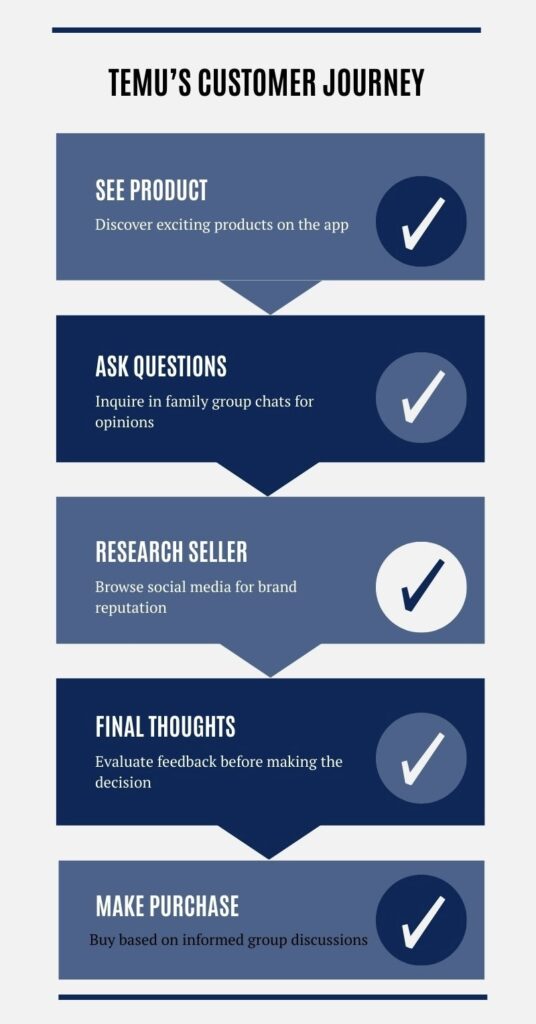
This changed everything.
Price Sensitivity Has Layers
Everyone assumed Nigerians just want “cheap.” The truth was more nuanced:
- Value consciousness: They want to know they’re getting their money’s worth
- Comparison shopping: They’ll research across 5+ platforms before buying
- Payment flexibility: How you can pay matters as much as how much you pay
- Hidden costs phobia: “Free shipping” that becomes expensive at checkout kills conversions instantly
The Strategy That Moved Mountains
Armed with these insights, I built what I called “The Bridge Strategy”, a framework designed to connect Temu’s global strengths with Nigerian market realities.
Phase 1: The Trust Foundation
Objective: Build brand equity and trust without aggressive sales pitches.
I initially wanted to go down this route first; The Cultural Conversation Approach: Instead of launching with “Buy from Temu!”, we started conversations around topics Nigerians actually cared about:
- “How to spot quality products when shopping online”
- “International shipping myths vs reality”
- “Your money, your choice: Payment options that actually protect you”
And then go on this;
The Twitter PR Playbook: We hijacked trending topics and cultural moments to insert Temu into conversations naturally:
- When #NaijaTwitter was discussing expensive local alternatives, we’d drop thoughtful threads about global options
- During major shopping festivals, we’d share educational content about making smart international purchases
- When consumers complained about poor service from competitors, we’d offer helpful alternatives (without directly promoting Temu)
The Influencer Authentication Strategy: Instead of paying big influencers for obvious ads, we identified micro-influencers who were already talking about e-commerce, international shopping, and consumer rights. We gave them early access to products and let them share authentic experiences, no scripts, no forced enthusiasm.
Phase 2: The Engagement Amplification
Everyone who engaged with our PR content on Twitter got retargeted on Facebook and Instagram with more specific, product-focused content.
But this wasn’t your typical “Buy now!” retargeting. This was contextual nurturing:
- If they engaged with content about phone accessories, they’d see curated phone accessory collections
- If they shared our posts about home decor, they’d get home styling inspiration featuring Temu products
- If they commented on posts about tech gadgets, they’d receive tech reviews and comparison guides
Phase 3: The Conversion Catalyst
The Warm Audience Activation: By month 3, we had built an audience of over 100,000 engaged Nigerians who knew about Temu, trusted the brand, and were primed for purchase.
Now we flipped the switch to conversion campaigns.
But even our sales campaigns were different:
- First-time buyer insurance that guaranteed satisfaction or full refund
- Local pickup points in major cities for people who didn’t trust home delivery
- Home delivery options
The Results Tracking System: We tracked everything:
- App downloads (obvious)
- Time spent in app before first purchase (trust indicator)
- Cart abandonment reasons (trust vs price vs logistics)
- Customer service inquiry themes (product quality, shipping, returns)
- Word-of-mouth mentions on social media (organic advocacy)
- Repeat purchase rates (long-term satisfaction)
The Results That Broke Records
Ninety days after we launched the strategy, the numbers told a story that even I found hard to believe:
- Temu became the #1 most downloaded app in Nigeria, overtaking established players like Chowdeck, Jumia, and even some social media apps. But downloads were just the beginning.
- App retention rates: 68% of users were still active after 30 days (industry average: 32%)
- Session duration: Average of 12 minutes per session (industry average: 4 minutes)
- Social media mentions: Over 25,000 organic mentions in the first quarter, with 78% positive sentiment
- Customer service ratings: 4.7/5 average rating
- Return/refund requests: 12% lower than projections
- Word-of-mouth referrals: 43% of new users came from friend recommendations
- First purchase conversion: 34% of app downloads resulted in purchases within 60 days
- Average order value: ₦8,400 (15% higher than initial projections)
- Repeat purchase rate: 56% of customers made a second purchase within 90 days
The Lessons That Changed How I Think About Market Entry
1. Culture Isn’t a Nice-to-Have, It’s Everything
You can have the best product, the biggest budget, and the smartest team. But if you don’t understand the cultural context you’re entering, you’re just throwing money into a black hole. The moment I discovered this, I went ahead to get an MBA in International Business. The aim was to better understand cultural nuances so as to better penetrate various markets.
Nigerian consumers aren’t “difficult” or “price-sensitive”, they’re experienced. They’ve learned to protect themselves in a market where consumer rights are still evolving. Respect that experience, and they’ll reward your brand with loyalty that lasts decades.
2. Trust Is the Only Currency That Matters
In mature markets, brands compete on features and benefits. In emerging markets like Nigeria, brands compete on trust. Every touchpoint, every interaction, every piece of content either builds trust or destroys it.
The brands that win are the ones that understand trust isn’t built through advertising, it’s built through consistent, authentic experiences that prove you’re worth the risk.
3. Platform Strategy Must Match Behavior Patterns
Global brands often make the mistake of assuming their preferred platforms are where local consumers want to engage. In Nigeria, the customer journey is multi-platform by nature:
- Discovery happens on Instagram and TikTok
- Research happens on Google and YouTube
- Validation happens on WhatsApp and X
- Purchase happens on apps and websites
- Support happens on WhatsApp, emails and phone calls
Your strategy needs to work across this entire ecosystem, not just the platforms you prefer.
4. Patience Is a Competitive Advantage
Most brands want immediate results. They launch with aggressive sales campaigns and wonder why Nigerian consumers run away faster than people hearing “there’s no light” during a Netflix binge.
The brands that win in Nigeria are the ones willing to invest 3-6 months in relationship building before expecting significant sales. It’s not slower, it’s strategic.
The Framework You Can Use
Based on the Temu success, I’ve developed what I call The Cultural Bridge Framework for international brands entering African markets:
Stage 1: Listen (Month 1)
- Conduct deep consumer research focusing on emotions, not just behaviors
- Map the real customer journey, not the ideal one
- Identify cultural touchstones and conversation themes
- Test all visual and copy elements with real users
Stage 2: Learn (Month 2)
- Analyze research findings for cultural insights
- Develop locally relevant messaging and positioning
- Create content that adds value before asking for sales
- Build relationships with local influencers and community leaders
Stage 3: Launch (Month 3)
- Start with educational and entertaining content
- Focus on building brand awareness and trust
- Use organic social media to start conversations
- Collect feedback and iterate quickly
Stage 4: Leverage (Months 4-6)
- Retarget engaged audiences with product-specific content
- Introduce sales campaigns to warm audiences
- Scale successful content and ad formats
- Build customer service and community management systems
Stage 5: Lead (Months 6+)
- Activate conversion campaigns for proven audiences
- Launch referral and loyalty programs
- Expand product categories based on performance data
- Document learnings for future market entries
What This Means for Your Business
Whether you’re a local Nigerian brand looking to scale or an international company eyeing the African market, the Temu case study offers some clear takeaways:
For Local Brands
- You have a cultural advantage – don’t throw it away by copying foreign strategies
- Build trust systematically – Nigerian consumers will reward authenticity with loyalty
- Use local platforms strategically – WhatsApp isn’t your regular communication tool, it’s a business platform, treat it as such
For International Brands
- Budget for relationship building – plan for 3-6 months of trust-building before expecting significant sales
- Hire local expertise – cultural fluency isn’t optional, it’s essential for success
- Adapt your entire approach – from payment options to customer service to content creation
For Marketing Professionals
- Data without context is dangerous – always combine analytics with cultural insights
- Platform strategy must match user behavior – not your preferences or global best practices
- Patience is a competitive advantage – slow, strategic approaches often win in emerging markets
The Bigger Picture
The Temu Nigeria success story isn’t a one off success for me making an app popular. What I did with the brand is something that I have done over and over again that shows what happens when you approach market entry as a cultural bridge-building exercise rather than a product-pushing campaign.
Great marketing isn’t about selling products. It’s about building bridges between brands and the people they want to serve. In Nigeria, those bridges are built with trust, maintained with consistency, and strengthened with authentic value.
Every market has its own language; linguistic, cultural, emotional, and behavioral. The brands that learn to speak that language fluently are the ones that enter those markets.
The question isn’t whether you can succeed in a market. The question is whether you’re willing to do the work to earn that success.
What’s Next?
The strategies that worked for Temu can be adapted for almost any brand looking to crack the Nigerian or broader African market. But adaptation is key; what works in e-commerce might need modification for fintech, edtech, or B2B services.
If you’re working on market entry, expansion, or just want to understand how Nigerian consumers really think and behave, the lessons from this case study are your starting point.
The bridge between your brand and your target consumers is waiting to be built. The question is: are you ready to put in the work?
Love, light and amazing marketing,
The Tochy of Tochy’s POV.
Simplifying Marketing for the Modern Business.