
There is a moment in almost every SaaS company’s journey where the growth model that got them here stops being sufficient to get them to their next phase of growth.
For product-led companies, it usually looks like this: the self-serve motion is humming. Thousands of users are signing up every month. Usage metrics look strong. But when it comes time to close a six-figure enterprise deal, the product alone cannot carry the conversation. The CISO needs a security review. The CFO needs a pricing negotiation. The VP needs a demo tailored to their specific use case. The product does not do those things, a person does.
For sales-led companies, it looks different but the pain is the same: the sales team is closing deals, but every single customer costs the same to acquire. There is no compounding. No organic pull. No users discovering the product on their own and falling in love with it before a salesperson ever makes contact. Every quarter starts at zero, and pipeline generation feels like pushing a boulder uphill repeatedly.
Both of these companies eventually arrive at the same conclusion: we need the other motion to break this growth ceiling.
The product-led company needs a sales layer to capture enterprise value. The sales-led company needs a product-led layer to create organic demand and reduce CAC. And so they build a hybrid growth model.
Except most of them do it badly.
They bolt a sales team onto a PLG product without changing the product’s architecture to support a sales handoff. Or they add a free trial to an enterprise product without rethinking pricing, onboarding, or activation. The result is not a hybrid model of their dreams, it is two separate motions running in parallel, competing for the same resources, confusing the same customers, and compounding nothing.
This piece is about how to build a hybrid growth model that actually works. Not the theory of it. The structural, operational, and organisational reality of combining product-led and sales-led growth in a way that makes each motion reinforce the other rather than cannibalise it.
If you have not already read my breakdown of the five types of growth models, start there. That piece establishes the foundations of PLG and SLG as individual motions. This piece assumes you understand both and are ready to talk about what happens when you combine them.
Most Companies Running Hybrid Growth Are Doing It by Accident
Usually, a product-led company reaches $5M or $10M in ARR and starts getting inbound requests from larger organisations that want to use the product but need procurement-grade onboarding, custom contracts, and a dedicated account manager. At this point, the company hires a few salespeople to handle these requests. The salespeople start closing deals. Revenue from enterprise accounts grows. Nobody formally redesigns the growth architecture to account for this second motion. The PLG motion keeps running. The sales motion keeps running. They operate on different timelines, track different metrics, and report to different leaders.
From the sales-led side, the pattern is a mirror image. A sales-led company watches a competitor gain traction with a freemium tier and decides to launch one. The free tier attracts users but the company never builds the activation infrastructure, the in-product upgrade triggers, or the PQL-to-SQL handoff that would turn those free users into revenue. The free tier becomes a cost centre that marketing reports on and sales ignores.
I wrote about this dynamic in Why Your Growth Model Is Broken. The fourth root cause I identified, functional silos, is almost always the structural driver behind accidental hybrid models. Each function optimises for its own metric. Nobody owns the compound outcome. The loop never compounds.
The pivot from accidental hybrid to intentional hybrid is one of the highest-leverage structural decisions a leadership team can make. But it requires understanding what an intentional hybrid model actually looks like.
What a Hybrid Growth Model Actually Is
A hybrid growth model is a deliberate growth architecture in which a product-led motion and a sales-led motion operate as complementary stages of a single customer journey, not as parallel, independent acquisition channels.
That distinction is everything.
In a well-designed hybrid model:
- The product-led motion creates demand, drives initial adoption, and qualifies users through their behaviour inside the product.
- The sales-led motion captures the commercial opportunity that the product-led motion has surfaced, converting activated users and accounts into enterprise contracts, expanded seats, and higher-tier plans.
- The two motions share data, share a customer journey map, and are measured against shared revenue outcomes.
In a poorly designed hybrid model (which is most of them):
- The PLG motion and the sales motion operate independently with separate funnels, separate metrics, and separate definitions of a qualified lead.
- Sales does not trust the leads coming from the product because there is no shared definition of what a Product Qualified Lead looks like.
- Marketing is caught in the middle, unsure whether to optimize for self-serve signups or for sales-assisted pipeline.
- The customer experiences friction at the handoff between the self-serve experience and the sales experience, often being asked to repeat information, sit through a demo of features they have already used, or navigate a pricing conversation that contradicts what they saw in the product.
The Two Entry Points: Bottom-Up PLG and Top-Down Sales
In a hybrid model, customers can enter through two doors. Understanding these doors and how they connect is the foundation of the architecture.
Bottom-up: the product-led entry
An individual user, a developer, a marketer, an analyst, an operations manager, discovers the product, signs up for a free tier or trial, and starts using it. They experience value. They invite colleagues. Usage spreads within the organisation from the bottom up. At some point, the account reaches a threshold of usage, seats, or feature requirements that triggers a commercial conversation.
This is how Slack, Notion, Figma, and Datadog built their enterprise businesses. Individual adoption created organisational demand. The sales team did not cold-call these accounts into existence. The product did the work of proving value. Sales captured the value that the product had already created.
Top-down: the sales-led entry
A senior buyer, a CTO, a VP of Marketing, a Head of Operations, identifies a need and evaluates solutions through a traditional procurement process. They want a demo, a proposal, a security review, and a negotiated contract. They may or may not have used the product before the conversation starts.
In a hybrid model, the top-down entry still exists. Enterprise buyers with complex procurement requirements are not going to self-serve into a six-figure annual contract. They need a human. But the sales motion is dramatically more efficient because the product has already been doing the selling: the buyer’s team is already using the free tier, usage data proves the product works, and the sales conversation starts at “how do we formalise this” rather than “what does this product do.”
The magic of hybrid: when both doors lead to the same room
The power of a well-designed hybrid model is that both entry points converge. The bottom-up user who adopted the product individually becomes an internal champion who accelerates the top-down sales conversation. The top-down buyer who signed an enterprise contract drives adoption faster because they mandate usage across the organisation, feeding the product-led retention loop.
When this works, the result is a growth model with lower CAC than pure sales-led, higher ACV than pure PLG, and stronger retention than either because the product has been validated by actual usage before the contract is signed.
When it does not work, you get two disconnected funnels, confused customers, and a sales team that resents the product team for “giving away” what they are trying to sell.
When Hybrid Makes Sense
Hybrid is not the right model for every company. It is the right model for companies that meet specific structural conditions. Forcing hybrid on a company that does not meet these conditions creates complexity without compounding growth.
Hybrid makes sense when:
- Your product delivers immediate, demonstrable value to individual users AND your revenue model requires or benefits from larger, negotiated contracts. This is the classic SaaS pattern: developers love the product, but procurement requires a sales conversation.
- You have a broad addressable market with both self-serve buyers and enterprise buyers. A single motion cannot serve both efficiently.
- Your product naturally creates in-organisation virality. When one user’s adoption leads to multiple users within the same account, you have the organic expansion dynamic that hybrid models depend on.
- Your average contract value justifies a sales motion for larger accounts but not for every account. If every deal is $500/year, you cannot afford a sales touch. If every deal is $500,000/year, you do not need a free tier. The hybrid sweet spot is the middle: a range of deal sizes where some customers self-serve and others need human-assisted conversion.
To understand whether your business architecture supports hybrid, refer to my piece on B2B vs. B2C vs. B2B2C business models. B2B companies with a developer or practitioner user base are the strongest candidates for hybrid. B2B2C models can also benefit when the product-led motion operates at the consumer layer while the sales motion operates at the business partner layer.
Hybrid creates chaos when:
- Your product does not deliver standalone value to individual users. If the product only works when the whole organisation adopts it, PLG has nothing to stand on. You need a sales motion to get the organisation on board first.
- Your market has a single buyer persona with a uniform buying process. If all your buyers buy the same way, one motion is more efficient than two.
- You do not have the organisational capacity to manage two motions simultaneously. Hybrid requires cross-functional coordination, shared data infrastructure, and clear handoff protocols. If your team is still figuring out one motion, adding a second will fragment your focus, not double your growth.
- Your pricing architecture does not support both self-serve and enterprise tiers. If there is no natural upgrade path from the free product to the paid product to the enterprise contract, the handoff breaks.
The PQL-to-SQL Handoff
If I had to identify the single point of failure that kills the most hybrid growth models, it is this: the handoff between Product Qualified Leads and Sales Qualified Leads.
In a pure PLG model, the product does all the qualifying. In a pure sales-led model, the SDR team does the qualifying. In a hybrid model, both are happening simultaneously, and the transition between them is where everything either compounds or collapses.
What is a Product Qualified Lead?
A PQL is a user or account that has demonstrated, through their behaviour inside the product, that they are likely to convert to paid or expand to a higher tier. Unlike a Marketing Qualified Lead, which is based on content engagement like downloading a whitepaper or attending a webinar, a PQL is based on product usage data.
Examples of PQL signals:
- A free-tier user who has hit the usage limit three times in the past month.
- An account with 15 active users on the free plan, all in the same company domain.
- A user who has activated three of four core features within the first week.
- An account that has integrated the product with two other tools in their stack.
These signals tell you something that no whitepaper download can: this user has experienced the product’s value and their behaviour indicates readiness for a commercial conversation.
Why the handoff breaks
The handoff breaks for three common reasons:
1. No shared definition of PQL between product and sales.
The product team defines PQLs based on usage metrics they find interesting. The sales team ignores those PQLs because the signals do not correlate with the accounts they actually want to sell to. There is no shared, data-validated definition of what constitutes a product-qualified account that both teams have agreed on and tested.
2. The sales experience contradicts the product experience.
The user has been self-serving happily for weeks. They know the product. They have configured it for their workflow. Then a salesperson reaches out, asks them to schedule a 45-minute discovery call, walks them through a generic demo of features they have already used, and sends them a proposal that looks nothing like the pricing they saw in the product. The experience goes from frictionless to frustrating in one interaction.
3. Timing is wrong.
Sales reaches out too early, before the user has experienced enough value to want a conversation, and the outreach feels intrusive. Or sales reaches out too late, after the user has already decided the free tier is sufficient and has no appetite for an upgrade conversation. The window for a sales-assisted conversion is specific and product usage data should be defining when it opens.
How to fix the handoff
- Build the PQL definition collaboratively. Product, marketing, and sales need to sit in the same room and agree on the behavioural signals that indicate sales readiness. Then validate the definition against historical data: do accounts that exhibit these behaviours actually convert at a higher rate? If not, refine the definition until they do.
- Make the sales experience an extension of the product experience, not a departure from it. The salesperson should reference the user’s actual product usage, acknowledge what they have already set up, and focus the conversation on the specific value they would unlock by upgrading. Never ask a PQL to sit through a demo of features they have been using for three weeks.
- Automate the timing trigger. Use product usage data to define the specific behavioural threshold that opens the sales window. When an account crosses that threshold, the sales team is notified with full context: who the active users are, what features they are using, how frequently they are engaging, and what usage limits they are approaching. The salesperson enters the conversation informed, not cold.
How to Structure Your Team for Hybrid Growth
The organisational structure of a hybrid growth company is meaningfully different from either a pure PLG or a pure sales-led company. Getting the structure wrong is one of the most common and most expensive mistakes.
The growth team sits between product and sales
In a hybrid model, you need a growth function that owns the middle of the journey, the space between a user signing up (product’s domain) and a deal closing (sales’s domain). This growth function is responsible for activation, expansion signals, PQL identification, and the handoff to sales.
Without this connecting layer, product and sales operate as two separate businesses that happen to share a logo. Product optimises for signups and engagement. Sales optimises for closed revenue. Nobody optimises for the conversion from product user to paying customer, which is the entire value proposition of the hybrid model.
Sales in a hybrid model is different from traditional sales
Your enterprise sales team in a hybrid model is not cold-calling prospects who have never heard of you. They are engaging with accounts that are already using the product. This changes the skill profile: you need salespeople who can read product usage data, understand where the user is in their journey, and have a consultative conversation about expanding value rather than a persuasive conversation about why they should care in the first place.
The worst thing you can do is hire a traditional enterprise sales team trained in outbound-heavy, relationship-first selling and point them at PQLs. The PQL does not need to be convinced the product works. They already know it works. They need help navigating internal procurement, justifying the budget, and structuring the contract. Different skills. Different motion. Different hire.
Customer success is a growth function, not a support function
In a hybrid model, customer success plays a direct revenue role. Existing customers who are on self-serve plans are the warmest possible pipeline for enterprise expansion. The CS team should be monitoring product usage across the customer base, identifying accounts that have outgrown their current plan, and surfacing those accounts to sales with full context.
This means CS needs access to the same product usage data that the growth team uses to identify PQLs. In most organisations, CS is working off a separate CRM view, with no visibility into the product analytics that would tell them which accounts are ripe for expansion. Fix the data access and you fix one of the biggest revenue leaks in the hybrid model.
The Metrics That Govern a Hybrid Growth Model
One of the clearest signs that a company is running an accidental hybrid versus an intentional one is the metrics they track. An accidental hybrid tracks PLG metrics and sales metrics separately. An intentional hybrid tracks metrics that measure the compound effect of both motions working together.
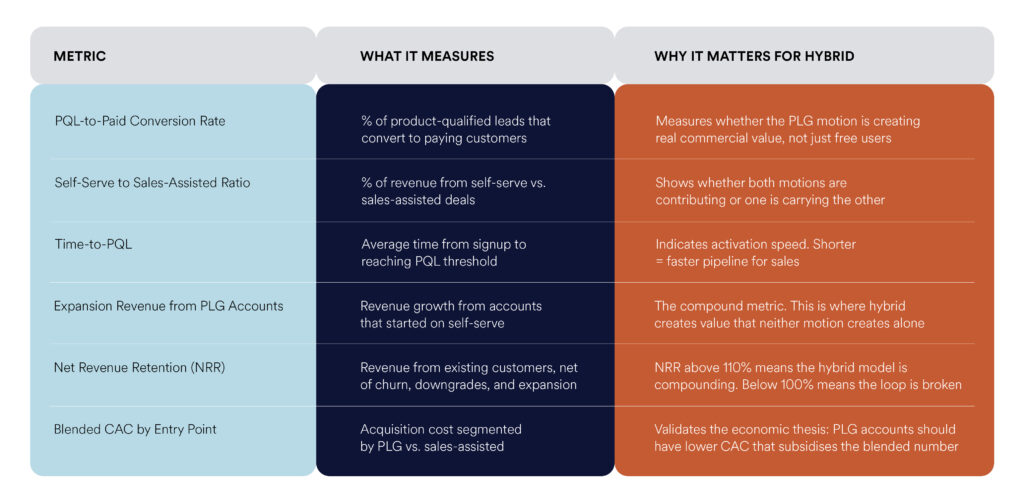
The metrics that govern a hybrid growth model
The single most important metric in a hybrid model is expansion revenue from PLG accounts. This is the metric that tells you whether the hybrid architecture is actually working, whether users who entered through the product are expanding into larger commercial relationships. If this number is growing, the model is compounding. If it is flat, you have two parallel motions, not a hybrid.
The Hybrid Growth Model at $1M, $10M, and $50M ARR
The shape of a hybrid model changes as the company scales. What works at $1M ARR will not work at $50M, and prematurely building for $50M at $1M creates overhead that slows you down.
At $1M ARR: pick a primary motion, design for the second
At this stage, you almost certainly have one dominant motion. Either the product is driving most of the revenue through self-serve, or a small sales team is closing most of the deals. The hybrid ambition at this stage is not to run both motions at full scale. It is to understand which accounts are showing organic expansion behaviour and design the first version of your PQL definition.
What this looks like practically: one or two people who sit between product and sales, watching product usage data, identifying accounts that look like they are outgrowing the free tier, and having informal conversations with those accounts about what an upgrade might look like. This is not a formal sales process. It is a listening and learning process that teaches you what the hybrid motion will eventually need to look like.
At $10M ARR: formalise the hybrid architecture
At this stage, the hybrid model needs to be intentional. You need a formal PQL definition that product, marketing, and sales have agreed on. You need a growth team that owns the activation-to-expansion journey. You need a sales team that is trained to engage with product-qualified accounts rather than cold prospects. And you need a shared dashboard that tracks the metrics above.
This is also the stage where pricing architecture becomes critical. Your self-serve pricing needs to create a natural ceiling that triggers the enterprise conversation. If the free tier is too generous, accounts never hit the expansion trigger. If it is too restrictive, users churn before they have experienced enough value to become PQLs. The pricing architecture is the mechanism that converts product-led adoption into sales-assisted revenue. Get it wrong and the hybrid model stalls.
At $50M ARR: optimise the loop, do not add complexity
At this stage, the temptation is to add more motions: channel partnerships, marketplace strategies, geographic expansion. Those can all be valuable, but the core hybrid loop, PLG feeding sales feeding expansion feeding advocacy, needs to be compounding before you layer on additional complexity.
The companies that break through $50M ARR with a hybrid model do it by relentlessly optimising the existing loop: faster time-to-PQL, higher PQL-to-paid conversion, larger expansion deals from existing accounts, better NRR. Each percentage point of improvement in the loop compounds across the entire customer base. Adding a new motion does not compound. It adds.
Common Hybrid Growth Mistakes That Kill Compounding
I have watched enough hybrid implementations go wrong to identify the patterns. These are the mistakes that kill the compounding effect and turn a hybrid model into an expensive, confusing mess.
Mistake 1: Letting sales cannibalise the self-serve motion.
A salesperson sees a high-usage free account and reaches out with a cold pitch before the account has hit any PQL threshold. The user was happily self-serving, considering upgrading organically, and the unsolicited sales outreach created friction that pushed them away. This happens when sales does not have clear rules of engagement about which accounts they can touch and when.
Mistake 2: Building separate funnels instead of one journey.
Marketing creates one funnel for self-serve signups and a completely separate funnel for enterprise leads. The two funnels have different landing pages, different messaging, different nurture sequences, and different definitions of success. The customer who starts on the self-serve path and later wants an enterprise conversation has to re-enter the system from scratch. The journey should be one path with multiple lanes, not two separate roads.
Mistake 3: Using MQLs instead of PQLs as the handoff signal.
In a hybrid model, the product is your best qualifying tool. A user who has activated three features and invited five colleagues is a stronger signal than a user who downloaded a whitepaper. If your sales team is still receiving MQL lists based on content engagement while ignoring product usage data, you are running a marketing-led model with a PLG product bolted on. That is not hybrid. That is confused.
Mistake 4: Pricing that creates a cliff instead of a staircase.
Free tier at $0. Next tier at $499 per month. Nothing in between. The user who has been happily using the free product for six months sees that price and closes the tab. A well-designed hybrid pricing architecture creates a natural staircase: free to starter to professional to enterprise, with each step delivering clearly more value and each transition feeling like a logical next move rather than a financial leap.
Mistake 5: No single owner of the hybrid model.
Product owns PLG. Sales owns enterprise. Marketing owns demand gen. Customer success owns retention. Nobody owns the hybrid loop. Nobody is accountable for whether the two motions are reinforcing each other. Nobody can tell you with data whether a self-serve user who expanded into an enterprise deal generated a lower CAC and higher LTV than a pure enterprise acquisition. Without that ownership, the model never gets the cross-functional coordination it needs to compound.
Building the Connective Tissue: Making PLG and Sales Reinforce Each Other
The difference between a hybrid model that compounds and one that fragments is connective tissue, the shared infrastructure, shared data, and shared accountability that makes the two motions work as one system.
Shared data layer
Product usage data and CRM data need to live in the same place, or at the very least, be connected in a way that gives every function visibility into the full customer journey. When a salesperson opens an account in the CRM, they should see the product usage data: active users, features adopted, usage frequency, integration status. When the growth team identifies a PQL, the signal should appear in the sales pipeline automatically with full context.
Most companies have these data sets in separate systems with no integration. Fixing this is not glamorous work, but it is the single highest-leverage infrastructure investment a hybrid company can make.
Shared customer journey map
Product, growth, marketing, sales, and customer success should all be operating from the same journey map, a documented, agreed-upon description of how a customer moves from first touch to expansion, with clear ownership at each stage and clear handoff protocols between stages. This map should specify: what triggers the transition from one stage to the next, who owns each stage, what data is passed at each handoff, and what success looks like at each stage.
Shared north star metric
In a hybrid model, the north star cannot be signups (that is PLG’s metric) or closed revenue (that is sales’s metric). It needs to be a compound metric that captures the value of both motions working together. Net Revenue Retention is the strongest candidate for most hybrid companies, because it captures both retention and expansion, both of which are driven by the product-led motion feeding the sales-led motion.
When NRR is the shared north star, every function understands that their job is not just to acquire or close or retain. Their job is to make the existing customer base more valuable over time. That alignment is what makes the hybrid model compound.
The Model Is the Multiplier
A hybrid growth model, when designed intentionally and governed with shared accountability, is the most powerful growth architecture available to SaaS companies today. It combines the capital efficiency of product-led adoption with the revenue scale of sales-led conversion. It creates organic demand that reduces CAC while maintaining the high ACVs that enterprise sales delivers. And it builds a retention loop where product usage validates the purchase decision, which reduces churn and drives expansion.
But it only works if it is one system, not two.
The product-led motion and the sales-led motion are not competing strategies. They are complementary stages of a single growth loop. The product earns trust. Sales captures value. Customer success deepens the relationship. The customer expands. The loop repeats.
If your PLG motion is generating signups but your sales team is ignoring them, the loop is broken. If your sales team is closing enterprise deals but none of those accounts started as self-serve users, the loop does not exist. If both motions are running but nobody can tell you with data how a user moves from free signup to enterprise contract, you do not have a hybrid model. You have two strategies that happen to share a building.
The companies I have watched compound revenue most effectively, across Africa, EMEA, and North America, are not the ones that picked the right single motion. They are the ones that figured out how to make two motions work as one.
That is the work. And it starts with a decision: stop running two growth strategies in parallel and start building one growth system that uses both.
Written by Tochy Emereole, a marketing and growth consultant helping companies across EMEA and NA build revenue engines that scale predictably. Visit https://tochyemereole.com/ or book a strategy consultation to talk growth.