
I typically ask the leadership team this one question every time I start consulting with a new organization:
“How does your company grow?”
Not ‘what does your marketing calendar look like.’ Not ‘what’s your sales process.’ I mean: how does your company, structurally and fundamentally, add revenue?
The answers tell me more about an organization’s growth ceiling than any dashboard ever could.
Some leaders answer with clarity and confidence. Most pause. A few look at each other. Some give me the answer they think I want to hear.
The ones who pause are not necessarily failing. They are being honest about something most leadership teams never say out loud: they have never formally defined their growth model. They have a collection of growth activities ranging from campaigns, channels, sales motions to content calendars but no shared, documented understanding of how those activities are supposed to compound into a structural growth advantage.
That gap is one of the most expensive structural blind spots in mid-market businesses today.
This piece is about closing it. We’re going to walk through what a growth model is, the five primary types of growth models operating in business today, what each looks like in practice, and how to identify which one actually fits how your company creates value.
First, What Is a Growth Model?
A growth model is not a marketing plan. I want to be direct about that because the two get confused constantly, and the confusion is expensive.
A marketing plan describes the campaigns, channels, and content you will deploy. A growth model describes something deeper: how your company creates value, delivers it to customers, and captures revenue from it at scale in a way that compounds over time rather than requiring constant reinvestment to sustain.
A growth model answers three specific questions:
- What is the primary mechanism through which your company acquires customers?
- What keeps those customers, expands their value, and turns them into advocates?
- How does revenue compound rather than just accumulate over time?
If you can answer those three questions with precision, you have a growth model. If your answer to any of them is ‘we do a bit of everything,’ you have growth activities. Activities are not a model.
A growth model is the answer to: how do we grow on purpose, at scale, without requiring heroics every quarter? If you can’t answer that clearly, you don’t have a model. You have a to-do list.
Why does it matter this much? Because your growth model determines everything downstream; your team structure, your technology stack, your KPI hierarchy, your budget allocation logic, and where you experiment first. A company that invests in product-led growth infrastructure when it actually needs a sales-led motion will misallocate resources for years before it figures out why the returns never arrived. There are professionals who could guide you during the phase of figuring this out, you however still have your own work cut out for you.
To better understand which growth model works for your business, you should read my article of what type of business you actually have as this forms the foundation for determining your growth model.
The 5 Types of Growth Models
Most companies operate one dominant model with elements of a second layered on as they scale. Understanding all five is the foundation of any growth strategy worth building because you can’t choose intelligently from a menu you’ve never read.
Growth Model 1: Product-Led Growth (PLG)
The core mechanic
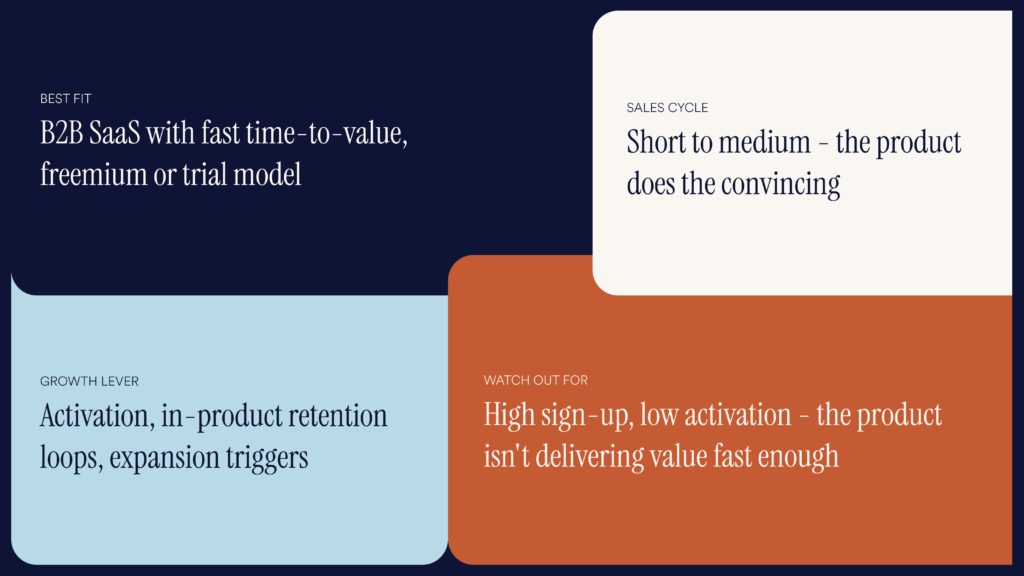
In product-led growth, the product itself is the primary acquisition and conversion engine. Users experience value before they pay. Freemium tiers, free trials, and in-product virality do the heavy lifting that sales and marketing do in other models. The product earns the sale.
Think Slack, Notion, Dropbox, Figma – companies where the first interaction with the product is the beginning of the sales process. The product is so immediately valuable that using it creates the motivation to pay for it.
Where it thrives
B2B SaaS companies with products that deliver immediate, demonstrable value. The ‘aha moment’ is fast, the friction to adoption is low, and the product naturally creates network effects or sharing behavior. If the product gets more valuable the more people use it, you have PLG conditions.
What the growth motion looks like
In a product-led growth organization, the growth function lives closest to product. Growth and product teams co-own the activation funnel – the path from sign-up to the moment a user first experiences genuine value. Marketing’s primary role is top-of-funnel awareness and SEO, driving users into the product experience rather than into a sales cycle. Sales exists, but primarily to close larger enterprise accounts that began as organic product users.
The central obsession in PLG is time-to-value. Every unnecessary step between ‘signed up’ and ‘had the aha moment’ is a leak in the model. Fixing those leaks is the growth work.
The metric that matters most
Product Qualified Leads (PQLs). These are users who have reached the activation moment and are statistically likely to convert to paid. In a PLG company, PQLs are the north star. Not impressions. Not MQLs. Users who’ve experienced the product deeply enough to have a commercial conversation.
If you already figured out that your business runs a PLG model but need to set up a super star team, get your growth stack properly set up or need to break the growth ceiling that your PLG business has hit then let’s have a chat.
Growth Model 2: Sales-Led Growth (SLG)
The core mechanic
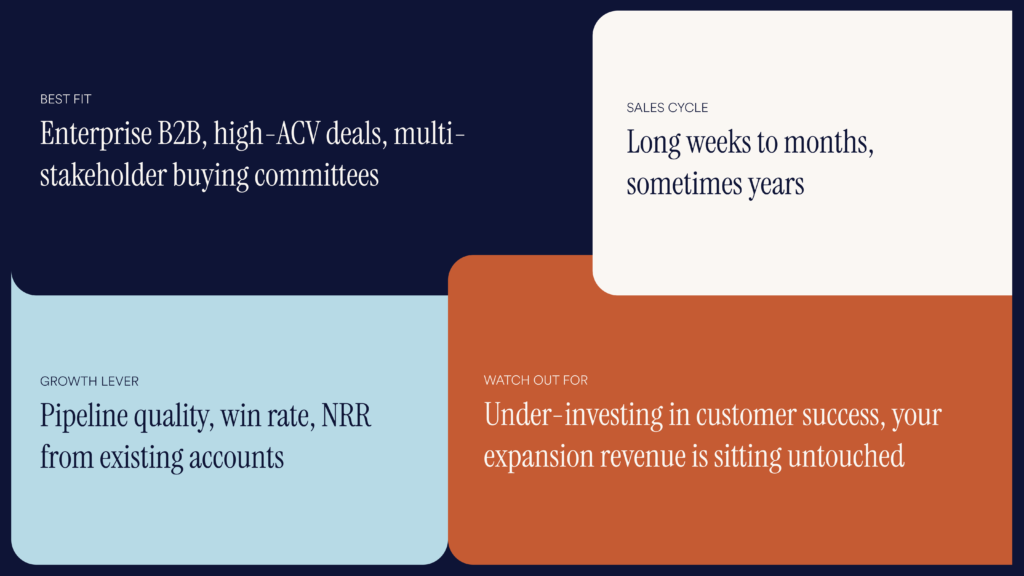
In sales-led growth, a human sales motion closes the majority of revenue. Discovery calls, proposals, negotiations, enterprise relationships, the sales team is the primary commercial engine. The product may be excellent, but buying it requires a conversation. There is also a lot of outbound effort here from the sales team.
This is the dominant model for enterprise SaaS, API businesses, professional services, and high-ACV B2B companies with complex buying committees. It is also, in my experience, the most frequently under-invested model when it comes to post-sale infrastructure.
Where it thrives
High-value, high-complexity products where the buyer needs to be educated, reassured, and guided to a decision. Industries with long trust-building cycles, regulatory considerations, or multi-stakeholder purchasing processes. If your deal involves more than two people signing off, you likely have a sales-led dynamic.
What the growth motion looks like
Marketing in a sales-led organization exists primarily to serve the pipeline and arm the sales team. Content strategy is built around enabling sales conversations – case studies, comparison frameworks, ROI calculators, value-added magnets, objection-handling assets. Demand generation is measured by sales-qualified leads and pipeline influenced, not by engagement metrics.
The two most chronically underinvested areas in sales-led organizations are marketing and customer success and that combination is a critical mistake, because in this model, the two functions are more interdependent than most leadership teams recognize.
On the marketing side: brand awareness is not a luxury in a sales-led business. It is the reason a prospect takes the call, trusts the case study, and doesn’t need three extra discovery sessions to be convinced you’re credible. Programmatic advertising, thought leadership content, and category-level positioning all reduce the friction in the sales cycle even when their impact is hard to attribute directly. An underfunded marketing team means an overworked sales team closing deals that should have been half as hard.
On the customer success side: account management in a sales-led model cannot be treated as a retention function alone. It is an expansion function. The customer is your highest-leverage revenue asset not because the relationship is sentimental, but because the cost of acquiring them was so high that extracting full value from the account is a financial imperative, not a growth ambition. Customer success teams need to be structured and resourced to grow accounts, not just protect them and marketing plays a direct role here, through account-based content, expansion campaigns, and re-engagement sequences that create upsell conditions before the CSM even makes the call.
Research consistently shows acquiring a new customer costs five to twenty-five times more than retaining an existing one.
In a sales-led model, customer success is not a support function. It’s a revenue function. Treat it accordingly.
The metric that matters most
Pipeline coverage ratio, win rate, average contract value, and Net Revenue Retention from existing accounts. NRR above 100% meaning existing customers are expanding faster than they’re churning is one of the most powerful growth signals a sales-led company can have.
If you need to speak to professional who has worked on multiple sales-led models with evidence, then let’s have a chat.
Growth Model 3: Marketing-Led Growth (MLG)
The core mechanic
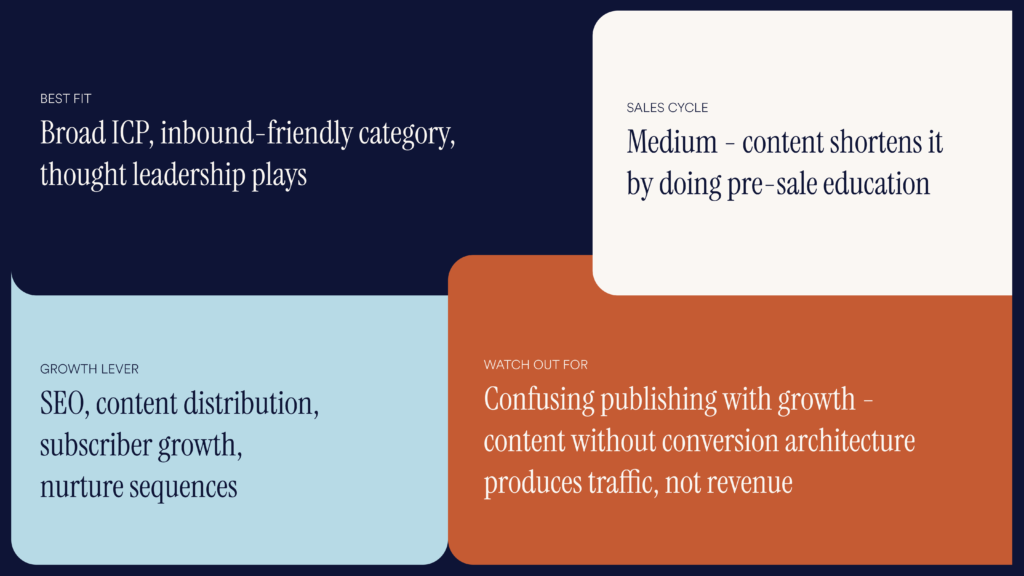
In marketing-led growth, content, SEO, paid acquisition, brand, and community build the pipeline. The marketing function is the primary commercial engine, with sales converting inbound interest rather than hunting outbound. The market comes to you because you’ve built something worth coming to.
HubSpot’s early model is the canonical example. Blog-first, inbound-first, product second. They built one of the most valuable content ecosystems in B2B marketing before they had a product that could compete on features alone. The content earned the audience. The audience enabled the business.
Where it thrives
Products with broad addressable markets, shorter evaluation cycles, and lower barriers to trial. Also particularly effective for companies where thought leadership creates long-term organic distribution advantages consulting practices, research-driven businesses, advisory firms, and B2B brands where trust is built before the sales conversation begins.
What the growth motion looks like
In a marketing-led growth organization, the content function is the most strategic investment on the table. Not because content is inherently valuable, but because in this model, content is the product that attracts people to the product.
The editorial calendar is a business strategy document, not a creative calendar. Every piece of content should have a clear role in the acquisition funnel: building awareness, capturing intent, nurturing consideration, or triggering conversion. Content without conversion architecture is just publishing. Content with a subscriber journey, a lead nurture sequence, and a measurement framework is a growth model.
This is also the model that most closely mirrors how I’ve built my consulting brand; Tochy Emereole using rigorous, opinionated content to build an audience of growth leaders and executives who trust the thinking before they ever consider working with Meridian Advisory. The content earns the relationship. The relationship enables the commercial conversation.
The metric that matters most
Organic traffic growth, content-attributed pipeline, cost per acquisition, conversion rates across the funnel, and subscriber growth as a leading indicator of future pipeline.
Growth Model 4: Community-Led Growth (CLG)
The core mechanic
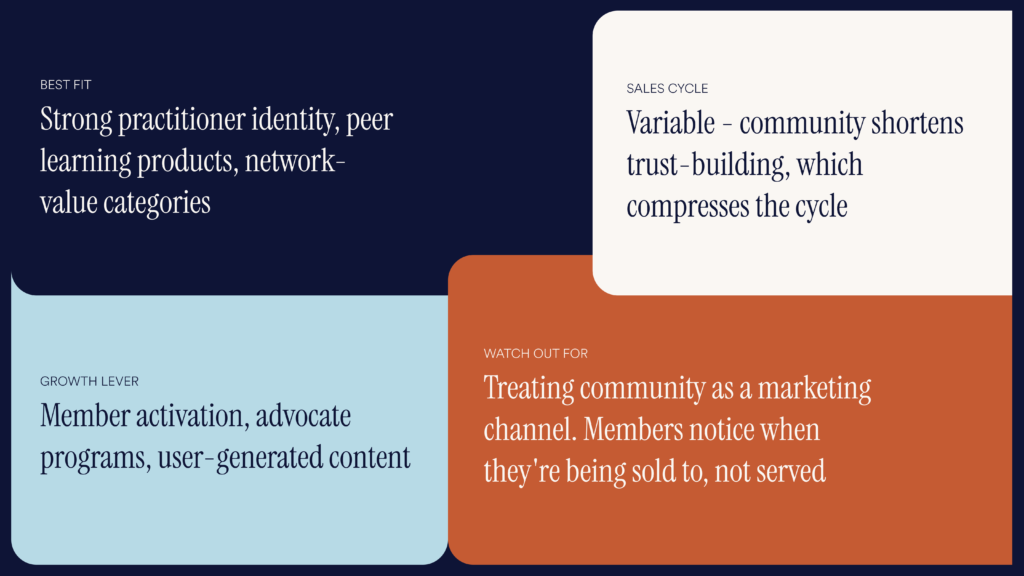
In community-led growth, a thriving community of practitioners, advocates, or enthusiasts becomes your most powerful acquisition and retention channel. The community generates content, drives referrals, creates social proof, and deepens product adoption often without direct company involvement in each individual interaction.
Think Notion’s template creator community, Figma’s design community, dbt’s data practitioner community. The company didn’t acquire those users with ads. The community pulled them in.
Where it thrives
Products with strong practitioner identity where using the product is part of how users define their professional self. Also highly effective for companies where peer-to-peer learning accelerates product adoption, or where user-generated content and templates create network value that the company alone couldn’t produce.
In African markets specifically, community-led growth is enormously underutilized. WhatsApp communities, Telegram groups, alumni networks, and professional associations are already operating as powerful trust-distribution channels. Companies that figure out how to build and activate these communities deliberately will have a significant structural advantage.
What the growth motion looks like
Community-led growth requires a dedicated community function, not a social media manager repurposed, not a customer success rep with a Slack channel. An actual community builder whose job is to make the community valuable for its members, independent of whether it also serves the company’s commercial interests.
That last part is critical. A community that exists primarily to sell to its members is not a community. It’s an audience. Communities grow through genuine peer value: shared learning, collective problem-solving, recognition, and belonging. When you build that deliberately, the commercial outcomes follow naturally.
- Onboarding into a community accelerates product activation. Users who join an active community reach value faster because other members guide them.
- Community members churn at significantly lower rates. The switching cost isn’t just the product, it’s the relationships and status they’ve built inside the community.
- Advocates amplify your reach without a paid media budget. When community members publicly champion your product, that is worth more than any sponsored post you could buy.
The metric that matters most
Community health metrics – active member rate, engagement rate, member-generated content volume paired with downstream commercial metrics: referrals from community members, activation rates for community-sourced sign-ups, and churn differential between community members and non-members.
Growth Model 5: Partnership-Led Growth
The core mechanic
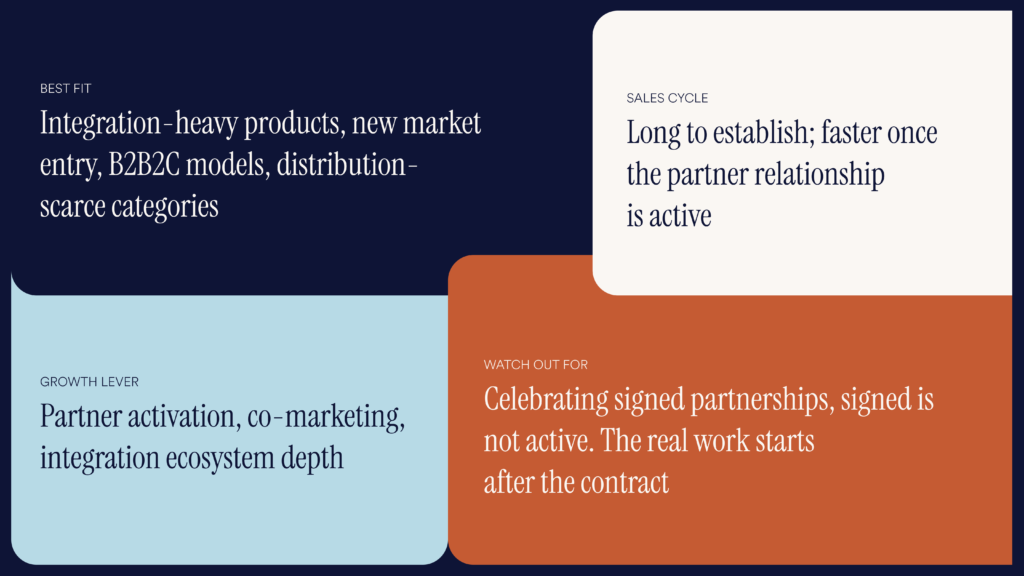
In partnership-led growth, strategic alliances, channel partners, integration partners, resellers, or co-marketing relationships become a primary driver of acquisition and revenue. You grow by plugging into other companies’ distribution rather than building all of your own.
This is more deliberate than it sounds. Partnership-led growth is not about sponsor logos at an event or a half-hearted affiliate program. It’s about engineering relationships where a partner’s success is structurally tied to your growth and vice versa.
Where it thrives
Companies where the product integrates naturally with other tools in the customer’s workflow. API and infrastructure businesses where your product powers someone else’s product. Companies entering new geographies where a local partner’s trust and distribution is more valuable than anything you could build from scratch. B2B2C models, by definition, have partnership-led growth embedded in their architecture.
What the growth motion looks like
Partnership-led growth requires a dedicated partnerships function, someone who manages the commercial, technical, and relational dimensions of each alliance. The biggest mistake companies make with partnerships is treating them as a side project managed by whoever has bandwidth. Partnerships that drive real revenue are managed like accounts: with targets, quarterly reviews, co-marketing plans, and joint success metrics.
- Technology partnerships (integrations, marketplace listings, API ecosystems) create distribution through product embedding. Every company that integrates your tool becomes a channel.
- Channel partnerships (resellers, referral partners, distributors) give you market access without the cost of building a local sales team from scratch.
- Co-marketing partnerships (joint content, events, research) let you share audiences and build credibility in categories you’re not yet known in.
- Strategic alliances (deeper commercial arrangements with complementary businesses) can create preferential referral relationships that function as a consistent, low-CAC acquisition channel.
The metric that matters most
Partner-sourced revenue as a percentage of total revenue, partner-influenced pipeline, partner activation rate (the share of signed partners actually generating deals), and time-to-first-referral from a new partner.
How to Choose the Right Growth Model for Your Organization
Three diagnostic questions will get you most of the way there. Answer them honestly.
1. How does your best customer typically find you?
If the answer is through the product itself, a referral from another user, or a free trial: you have product-led characteristics. Invest in optimizing that motion.
If the answer is through a salesperson, an outbound sequence, or a business relationship: you have a sales-led foundation. Build your infrastructure around pipeline quality and customer success.
If the answer is through search, content, social, or an inbound marketing channel: you have marketing-led characteristics. Your content function is your most strategic investment.
If the answer is through a partner, a referral from a complementary business, or a channel relationship: your partnership motion is already working. Formalize it and invest in it.
If the answer is through a community, a practitioner network, or peer recommendation: community-led growth is your most underexploited asset.
2. How complex is your buying process?
Complex, multi-stakeholder, long-cycle processes (60+ days) almost always indicate a sales-led or hybrid model. Simple, self-serve, short-cycle purchases point toward PLG or marketing-led. The buying complexity is not something you choose, it’s something your category and customer dictate. Build your growth model to match reality, not aspiration.
3. Where does your revenue compound; in new acquisition or in existing customer expansion?
If your best revenue opportunity is in growing existing accounts i.e upselling, cross-selling, or increasing usage then you need to invest heavily in customer success as a growth motion, regardless of which primary model you operate. Companies that treat customer success as a cost center rather than a revenue engine consistently underperform on Net Revenue Retention. And NRR above 100% is one of the most powerful growth signals a company can have.
You cannot build the right growth infrastructure until you know which growth model you are building it for. Choosing the wrong model is how companies spend years building the wrong thing or building nothing at all.
A Note on Hybrid Growth: The Most Common and Most Mismanaged Model
Most scaling companies don’t operate a single growth model in isolation. They operate a hybrid; multiple motions running in parallel. Product drives adoption, marketing builds brand and pipeline, sales closes larger accounts, community deepens retention, and partnerships extend reach into new segments.
Hybrid growth is simultaneously the most powerful and the most dangerous configuration.
Powerful because it captures multiple growth levers at once. Dangerous because without clear governance; a shared north star metric, cross-functional alignment, and an explicit growth model document each motion becomes its own silo. The compounding effect that a well-designed hybrid model creates never materializes when the motions are running in parallel but not in concert.
Most companies operating a hybrid model are doing so accidentally. The pivot from accidental hybrid to intentional hybrid is one of the highest-leverage structural decisions a leadership team can make. It starts with naming which motions you’re running, measuring each one distinctly, and creating the connective tissue, usually a Head of Growth with cross-functional authority to make them reinforce each other.
Without that structural positioning, nobody can hold all motions accountable to the same growth model. And your ceiling stays lower than it needs to be.
The Model Is the Foundation, Not the Destination
A growth model is not a strategy document you write once and file away. It’s a living operational framework that needs to be revisited as your company evolves – as you move into new markets, add new products, shift customer segments, or cross revenue thresholds that change your structural needs.
The companies I’ve worked with across Africa, EMEA, and North America that break through their growth ceilings don’t do it because they found a smarter channel or a better tactic. They do it because someone, at a pivotal moment, sat the leadership team down and said: ‘We need to decide formally, clearly, and collectively how this company grows. And then we need to build the infrastructure to actually do it.’
That decision is what separates the companies that compound from the ones that plateau.
Five growth models. One organization. One dominant motion, with the right secondary layers as you scale. That’s the framework. Now: which one is yours?
To explore how I can help your organisation with your Go-to-market plan, visit https://tochyemereole.com/