
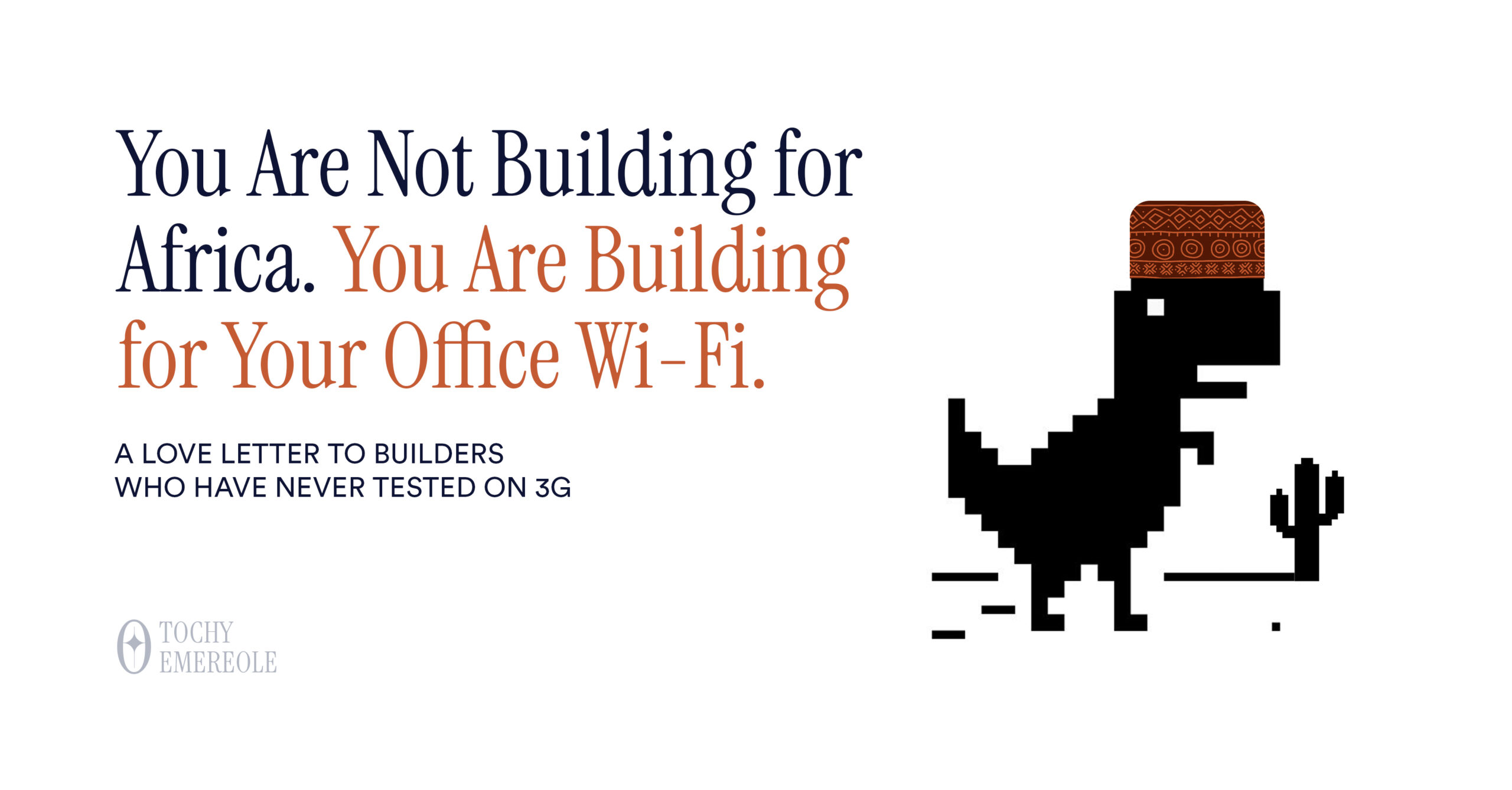
Recently, I went out for a business dinner with the CMO of one of the big fintechs in Nigeria. While he was telling me about some new ideas that he and his co-founders were ideating, he made a statement along the lines of accessibility; that you can only successfully build for the African market by actually going outside to ‘touch grass’ and understand the unique problems that face us here. Problems that are not prevalent in other parts of the world.
And just like that, me who was doing ‘I am a cool, calm, collected babe’ went off ranting.
I have held off on writing about this for the longest time. There was no space for this type of article in my already built-out editorial calendar for 2026. But I have had this conversation so many times recently, with people who seemed genuinely oblivious to this topic, that I felt the need to just write about it.
Let Me Start With Some Recent Product Experiences
The GymMaster app by i-Fitness is a terrible, data-consuming app. Every time I go to i-Fitness, signing in is a problem. The receptionist always says the same thing: “You are using Airtel and Airtel does not really work here. Maybe switch to MTN.” Meanwhile, I am listening to Diary of a CEO or I Said What I Said on YouTube just fine.
For some reason, they believe that absolutely nothing is wrong with their app. That everyone else is the problem and should be using MTN. Not that their app was not built with the realities of average Nigerians in mind. Not that it is not optimised for the failed infrastructural realities of a country like Nigeria.
Next would be the Clannit app, which cannot generate a visitor access code for my estate gate unless my internet is on at least LTE or a really strong 5G connection which sometimes I do not have across my MTN, Airtel, and FibreOne internet providers.
I speak for a lot of Nigerians when I talk about these problems. And I do not know how many CEOs, builders, and product people are privy to these realities, or how addressing them could exponentially improve the user experience on their platforms.
The Core Problem: Building Without Context
Nigerians and Africans as a whole face unique challenges that range from internet access and internet-sharing habits to phone storage constraints. Android phone companies like Xiaomi do not send 1TB devices to Nigeria for sale because the purchasing power is not there. The average smartphone sold on the continent has 32GB of storage. Four out of five smartphones sold in Africa cost under $200. The GSMA is piloting $40 smartphones across Nigeria, Ethiopia, and four other countries in 2026 just to close the digital divide.
But what about the companies building for this region? What considerations do they factor in when building?
Innovation and brilliance and a compelling Unique Selling Proposition do not excuse poor accessibility, inclusivity, and simplicity. How many times do we sit down and ask ourselves how what we are building will be accessed by the average Nigerian? As marketing folks, how many times do we listen to and research negative product feedback, make a business case for it, and take it to the product team to implement?
Features that might not make sense to the venture capitalist in Silicon Valley but make absolute sense to the average Nigerian earning ₦250,000 a month.
There are so many out-of-touch products where people are just expected to adopt magically. Your product not being adopted, competition easily displacing your market position, it might simply be because you built innovation and brilliance without factoring in the harsh realities of living in Africa.
Here are some of the unique problems that Africans face that could spark your next innovative idea or reshape how you optimize your current product.
Written by Tochy Emereole, a marketing and growth consultant helping companies across EMEA and NA build revenue engines that scale predictably. Visit https://tochyemereole.com/ or book a strategy consultation to talk growth.
1. Poor and Inconsistent Internet Connectivity
The reality
Nigeria has roughly 109 million internet users, but connectivity quality tells a very different story from penetration numbers. The average mobile download speed nationally is about 14.7 Mbps as of late 2025 and that is the average, which means a significant portion of users are operating well below that. Rural median download speeds sit around 16 Mbps. In many parts of Lagos, Abuja, and Port Harcourt, you will fluctuate between strong 4G and barely functional Edge connectivity within the same commute.
This is not a minor inconvenience. This is the operating environment that every app, every platform, and every digital product has to function within. And most of them are not built for it.
What this means for product and marketing teams
- Your app needs to work on 2G and 3G, not just on the 4G connection in your office. If your core functionality requires a stable, fast connection to operate, you have already excluded a large portion of your addressable market.
- Offline-first architecture is not a nice-to-have. It is a competitive advantage. Let users perform key actions offline and sync when connectivity returns. This is basic, but most products do not do it.
- Compress everything. Images, assets, API payloads. Every unnecessary kilobyte is a user who gave up and closed the app. Data is expensive here. People notice.
- As marketers, your landing pages, lead magnets, and ad destinations need to load in under three seconds on a mid-range phone with inconsistent 3G. If they do not, your cost per acquisition is inflated by infrastructure, not by creative.
- Test on real networks, not office Wi-Fi. If your QA team is testing on fibre, they are not testing for your actual user.
2. Limited Phone Storage
The reality
The most popular smartphones in Africa are not iPhones or Samsung flagships. They are Tecno, Infinix, and Itel, three brands under Transsion Holdings that collectively hold over 50% market share in Nigeria. These devices typically ship with 32GB to 64GB of storage and 2GB to 4GB of RAM. Android Go, designed for devices with as little as 1GB of RAM, has been pre-installed on over 40 million entry-level phones across Nigeria, Kenya, and Ethiopia.
When a user has 32GB of total storage and the operating system and pre-installed apps already consume half of that, every app is competing for the remaining space. And when your app is 150MB and growing with every update, you are one “storage full” notification away from being uninstalled.
What this means for product and marketing teams
- Keep your app size small. Under 30MB for the install package should be a hard target. Use app bundles, on-demand asset loading, and aggressive cache management. If your app is ballooning past 100MB, you are losing users to a problem they will never report, they will just delete you.
- Build lite versions or progressive web apps (PWAs). WhatsApp understood this. Facebook understood this. Many African fintechs and e-commerce platforms still have not.
- Think about what your app stores locally. Are you caching high-resolution images that the user never asked for? Are you downloading assets that could be streamed? Every megabyte of local storage you consume is storage your user wanted for something else.
- For marketers: that 40MB PDF lead magnet or heavy video ad creative? It is not landing. Optimise file sizes for mobile delivery. Make your downloads as light as your landing pages should be.
3. Low Purchasing Power
The reality
Nigeria’s minimum wage is ₦70,000 per month. That is roughly $42. The average monthly salary is about ₦339,000, approximately $220. The median, which is more telling is around ₦100,000, about $65. Inflation ran above 33% through 2024 and into 2025, eroding whatever purchasing power those numbers represent.
A minimum wage worker in Nigeria has purchasing power equivalent to earning about $2 per hour in the United States. Let that sit with you for a moment when you are setting your pricing.
What this means for product and marketing teams
- Your pricing model needs to reflect local economic reality, not your Silicon Valley unit economics benchmarks. A $9.99 monthly subscription that feels like nothing in San Francisco is nearly 10% of a median Nigerian’s monthly income. That is not a subscription. That is a major financial decision.
- Micro-pricing and pay-as-you-go models work here because they match how people actually manage money. Daily or weekly payment options, usage-based pricing, and tiered access are not compromises. They are the correct product-market fit for this economy.
- Free tiers need to be genuinely useful, not crippled demos. If your free tier is so limited that it is essentially an advert for the paid version, users will not upgrade. They will leave. A generous free tier builds habit, trust, and eventually conversion, that’s how to achieve product stickiness.
- For marketers: your cost-per-click might be low in African markets, but if your conversion funnel ends at a price point that is disconnected from local spending power, you are paying to generate frustration. The CAC math only works if the user can actually afford what you are selling.
- Localise your payment infrastructure. Not everyone has a credit card. Not everyone has a dollar card. Integrate mobile money, bank transfers, USSD payments, and local payment gateways. If your checkout page only accepts Visa and Mastercard, you have already filtered out a significant portion of your market.
4. Averseness to Reading Long-Form Text
The reality
This is not about literacy alone, though Nigeria’s adult literacy rate of about 70% means nearly one in three adults struggles with reading. Even among literate users, the preference in this market is overwhelmingly for visual and audio content over text. It is cultural, it is habitual, and it is reinforced by how people consume information on the continent.
WhatsApp voice notes dominate communication. YouTube and TikTok are primary information channels. People would rather watch a three-minute video explaining how to do something than read a five-paragraph article about it. This is not a deficit. It is a preference that your product and marketing need to respect.
What this means for product and marketing teams
- Your onboarding flow should not be a wall of text. Use video walkthroughs, animated tooltips, and visual guides. If you are relying on a help centre full of written articles to drive product adoption, you are losing users who will never read them.
- In-app communication should favour visuals, icons, and short, clear micro-copy over paragraphs of explanation. Show, do not tell. An icon with a one-line label will always outperform a text block.
- For marketers: video-first content strategy is not optional in this market. Short-form video, voice-over explainers, carousels, and infographics will consistently outperform long-form blog posts for engagement and conversion. This does not mean you stop writing, written content is still critical for SEO. But your distribution strategy needs to lean heavily into visual and audio formats.
- Error messages, notifications, and transactional communications should be written at a primary school reading level. Not because your users are not intelligent, but because clarity is always better than cleverness, and you are competing with every other notification on their phone.
- Consider multilingual and Pidgin English options. This alone can dramatically improve comprehension and trust, particularly outside Lagos and Abuja.
5. Poor Road Infrastructure
The reality
Only about 30% of Nigeria’s 195,000-kilometre road network is paved. Of the roads that are paved, a significant portion are in poor or failed condition with crater-sized potholes, flooding and disintegrating tarmacs. The economic cost is staggering: annual vehicle maintenance losses exceed ₦133.8 billion, and over 51% of vehicle users experience damage monthly from deteriorating roads.
This might seem like a logistics problem, not a product or marketing problem but it is both.
What this means for product and marketing teams
- If your product has a physical delivery component – e-commerce, food delivery, logistics, healthcare, your delivery promise is only as reliable as the road between your warehouse and your customer. Building delivery ETAs based on Google Maps estimates without accounting for road quality is how you erode trust and generate complaints faster than you generate orders.
- Last-mile logistics should be a core product consideration, not an afterthought. Your competitor is not the other app. Your competitor is the pothole that made the rider turn around and go home. Build redundancy into your fulfilment model.
- For marketers: do not promise what your infrastructure cannot deliver. “Delivery in 30 minutes” when the reality is two hours because of road conditions does more brand damage than any campaign can repair. Honest delivery windows build more trust than aspirational ones.
- Products that reduce the need for physical movement have a structural advantage in this market. Telemedicine, virtual banking, remote learning, digital commerce, anything that lets users access value without fighting traffic and bad roads has an adoption tailwind that products requiring physical presence do not.
6. Unreliable Electricity Supply
The reality
Nigeria has the largest electricity access deficits in the world. Approximately 86.8 million Nigerians, the highest number globally as some people have no access to electricity at all. For those who are connected to the grid, the experience is not much better: the average feeder experiences roughly 640 outages per year, amounting to approximately 160 days of blackout annually. That means Nigerians connected to the national grid go without power about 40% of the time.
The grid itself collapsed nine times in 2024 alone, and it collapsed again in January 2026, plunging the country into darkness.
What this means for product and marketing teams
- Your users are managing their phone battery like a scarce resource, because it is. If your app drains battery through constant background processes, location tracking, or aggressive push notification infrastructure, users will notice and they will uninstall you. Battery efficiency is a product feature in this market, not a technical footnote.
- Design for interrupted sessions. Users will start a task, lose power, and come back to it hours later. If your app does not save state, does not cache progress, does not let users resume where they left off, you are forcing them to start over every time NEPA takes the light.
- Reduce reliance on always-on connectivity. If your product requires constant server communication to function, it will fail during outages when users lose both their Wi-Fi router and their mobile data (because the cell tower is also running on a generator with limited fuel).
- For marketers: schedule your push notifications and email sends thoughtfully. Sending a time-sensitive promotion at 2pm when half your audience has no power and will not see it until 9pm is wasted timing. Understand the power patterns in your key markets and optimize send times accordingly. When do people typically put on their generators to charge their phones?
- Products that help people manage around the electricity crisis e.g solar solutions, battery management, offline entertainment, efficient appliances are not niche. They are addressing one of the most universal pain points on the continent.
7. High Levels of Functional Illiteracy and Digital Illiteracy
The reality
Nigeria’s adult literacy rate sits at about 70%, but this national average masks extreme regional disparities. In the South West, male literacy is 89%. In Yobe State in the North East, it drops to 7%. Even among those classified as literate, there is a significant gap between basic literacy and digital literacy – the ability to navigate apps, fill out forms, understand UI patterns, and use technology confidently.
This means a meaningful segment of your addressable market can use a phone to make calls and send WhatsApp voice notes but struggles with anything that requires reading menus, interpreting icons without labels, or completing multi-step digital processes.
What this means for product and marketing teams
- Simplicity is not dumbing down. It is designing with empathy. Your UI should be navigable by someone who has never used an app like yours before. This means large touch targets, clear visual hierarchy, minimal text, intuitive icons, and forgiving error handling.
- Voice interfaces and audio-guided experiences are not futuristic features. They are accessibility necessities. The most successful mobile money platforms in East Africa grew partly because agents could walk users through the process verbally and we are seeing this happen with the structure that Moniepoint and M-Kopa have built in the Nigerian market. Build products that support guided, human-assisted usage alongside self-service.
- Reduce the number of steps in every critical flow. Every additional screen, every additional form field, every additional confirmation is a drop-off point. If your user needs to complete seven steps to do the one thing they came to do, five of those steps are probably unnecessary, figure out how to minimize them.
- Use progressive disclosure. Do not show users everything at once. Reveal complexity gradually as they become more comfortable with your product. The most successful products in low-literacy markets start simple and then expand.
- For marketers: your ad creative, landing pages, and conversion flows need to work for users across the literacy spectrum. This means less text, more visuals, clearer calls to action, and fewer assumptions about what the user already knows. Test your campaigns with users outside of your bubble. The intern in your office is not your representative user.
Conclusion
None of these problems are new. There are a lot more. Every Nigerian reading this is nodding their head right now because they live these realities daily. The question is not whether these problems exist, it is whether the people building products and marketing them in this region are building with these problems in mind.
Too many products are built in air-conditioned offices on fibre internet with the latest iPhones, then launched into a market where the average user is on a Tecno with 32GB of storage, fluctuating between 3G and Edge, managing their phone battery because NEPA has not brought light in two days, on a road that takes 90 minutes to cover what should be a 20-minute commute.
That is not a market you can serve by copying a playbook from San Francisco or London. This is a market you serve by going outside, touching grass, talking to people, and building for the reality in front of you.
Innovation and brilliance mean nothing if the people you built for cannot access what you built. Accessibility, inclusivity, and simplicity are not meant to be afterthoughts here, they are the product.
Build for the reality. Not the aspiration.
Written by Tochy Emereole, a marketing and growth consultant helping companies across EMEA and NA build revenue engines that scale predictably. Visit https://tochyemereole.com/ or book a strategy consultation to talk growth.