
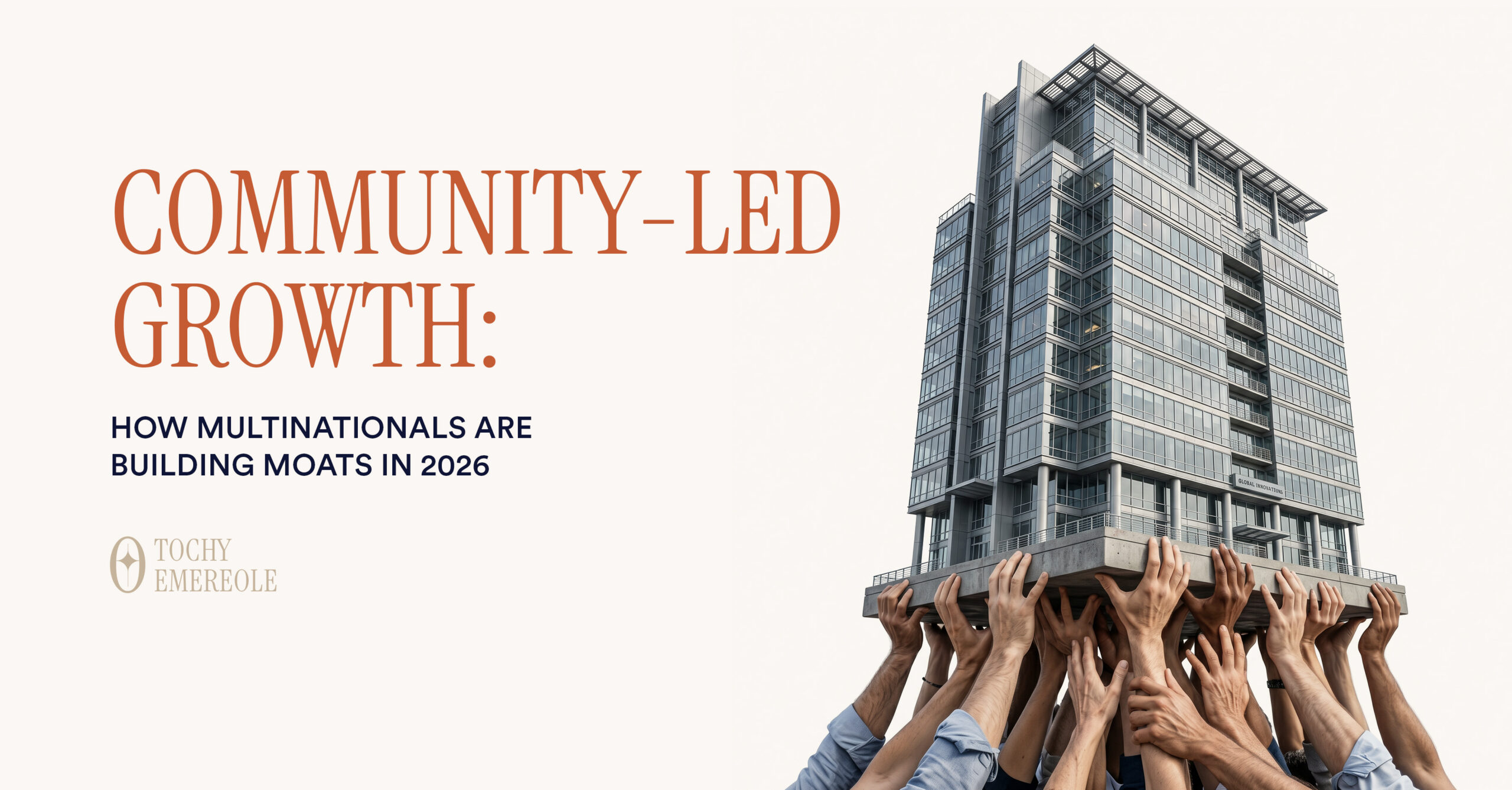
Let me tell you about a company that didn’t buy its growth.
dbt Labs, the data transformation tool. They built one of the most valuable B2B communities in tech without a traditional marketing machine. No Super Bowl ad. No aggressive outbound motion. No celebrity CMO. What they built instead was a Slack community of data practitioners – analysts, analytics engineers, data scientists who showed up daily to share workflows, debug each other’s code, argue about best practices, and genuinely help each other become better at their jobs.
By the time dbt Labs raised their Series D at a $4.2 billion valuation, their Slack community had tens of thousands of active members. More importantly, those members were the same people signing procurement requests at the companies dbt wanted as customers. The community was not only a marketing asset, it was the product’s distribution channel, its quality assurance function, its content engine, and its most effective sales tool all at once.
That’s community-led growth in practice. Not a loyalty scheme. Not a Facebook group with occasional brand updates. A deliberate, well-resourced, structurally embedded growth motion that compounds over time and becomes harder to replicate the longer you run it.
And in 2026, we are seeing more multinationals lean into this and those who figured it out first are pulling away from everyone else. This piece is about what they’re doing, how they’re doing it, and what you can learn from it regardless of your company’s size or geography.
And if you’d like to first learn about other types of growth frameworks and which best suits your business model, then start off by reading this article about the 5 types of growth models every growth leader should know.
What Community-Led Growth Is and What It Isn’t
Before we go further, let’s close the definitional gap, because there’s a lot of noise around this term.
Community-led growth (CLG) is a go-to-market strategy in which a deliberately built and actively maintained community of customers, practitioners, or advocates becomes a primary driver of acquisition, activation, retention, and expansion. The community does work that sales, marketing, and customer success would otherwise need to do and it does it at a fraction of the cost, with significantly more credibility.
Here’s what that is not:
- It is not your social media following. Followers are an audience. Communities are groups of people with reciprocal relationships with each other, not just with the brand.
- It is not a customer success Slack channel. A support channel is reactive infrastructure. A community is a proactive value-creation environment.
- It is not a referral program. Referral programs incentivize transactions. Community-led growth generates advocacy that is intrinsic where people recommend you because they genuinely believe in what you’ve built, not because they get a voucher.
- It is not free marketing. Building and sustaining a genuine community requires dedicated headcount, real investment, and long-term commitment. The returns are outsized but they are not free.
An audience is people listening to you. A community is people talking to each other. That distinction is the entire business case for community-led growth.
The reason community-led growth is having a renaissance in 2026 is not because community is a new idea. It’s because the macroeconomic conditions have made the alternative – paid acquisition and outbound sales as the primary growth motions significantly more expensive and less predictable.
CAC is up across nearly every major digital channel. Privacy changes have degraded targeting precision. Buyers are more skeptical of brand-to-buyer messaging and more trusting of peer-to-peer recommendation. In that environment, a brand community that generates organic referrals, peer testimonials, and genuine advocacy is not a nice-to-have anymore.
Why Multinationals Are Doubling Down on Community in 2026
The shift is just as philosophical as it is financial.
Multinationals are investing in community-led growth because the data on community members versus non-community members is increasingly impossible to ignore across every industry that has measured it properly. Community members retain longer. They expand more. They refer more. They require less support. And they provide product feedback that is qualitatively richer than anything a survey or a sales call will surface.
Let me give you the pattern across the companies doing this well.
Salesforce and the Trailblazer Community
Salesforce’s Trailblazer community is arguably the most studied example of community-led growth at enterprise scale. Millions of members. Thousands of user groups globally. A certification ecosystem that turns community participation into career capital, which in turn creates self-reinforcing incentives to stay active, stay current, and stay on the Salesforce platform.
The genius of Trailblazer is that Salesforce made community membership professionally valuable independent of the product. Trailblazer certifications are resume credentials. They signal competence to employers. That means a Salesforce administrator has a career incentive not just a product incentive to stay deeply embedded in the Salesforce ecosystem. Churn from Salesforce means churn from a professional identity that took years to build.
That’s a moat. Not a feature, not a price advantage, not a better demo. A moat built from community infrastructure.
Google has been trying to recreate this by the way.
HubSpot and the Inbound Community
HubSpot built its community around a methodology before it was a mature product company. ‘Inbound marketing’ was an idea HubSpot coined, championed, and turned into an annual conference – INBOUND – before most people could articulate what it meant. The community that formed around the methodology became the customer base for the product. The content marketing movement that HubSpot led didn’t just drive traffic. It created a generation of marketers who were ideologically aligned with HubSpot’s worldview before they ever opened a trial account.
That is community marketing as a go-to-market strategy: build the belief system first, and the product becomes the natural home for believers.
Figma and the Design Community
Figma’s community strategy was embedded in the product architecture itself. The ability to share design files publicly, remix templates, and publish community resources made every Figma user a potential community contributor. Designers shared their work. Other designers found it useful, joined the platform, and shared their own work. The community grew through genuine peer value exchange, not brand-managed engagement.
When Adobe acquired Figma for $20 billion, analysts pointed to market share and product quality. But a significant part of Figma’s defensibility was the community of 4 million designers who had invested time, reputation, and creative output into the Figma ecosystem. That community was not a marketing asset. It was a structural barrier to switching.
What Community-Led Growth Delivers
Let’s make this concrete. Here’s what a well-executed community-led growth strategy delivers across the revenue funnel and why it compounds in ways other growth motions don’t.
Acquisition: lower CAC through organic referral
Community members are your highest-quality referral source. They refer people who are already pre-qualified; people who are facing the same problems the community was built around, and who arrive with a baseline level of trust because a peer they respect sent them. Referred users consistently show higher activation rates, lower time-to-value, and better retention than users acquired through paid channels.
The math over time is compelling. Every community member who refers one new user is effectively reducing your blended CAC. At scale, a healthy customer advocacy program can move your blended CAC down by 20 to 40 percent without a single paid media optimization.
Activation: peer guidance accelerates the aha moment
One of the most underappreciated benefits of an active brand community is what it does to activation. New users who join a community don’t have to figure the product out alone. They ask questions. Experienced members answer. Best practices get shared. Pitfalls get flagged. The community functions as a distributed onboarding resource that is richer, faster, and more contextually relevant than any in-app tooltip sequence you could build.
In community-led SaaS companies specifically, the correlation between community engagement and product activation is one of the strongest leading indicators of retention that growth teams can track. If a new user engages meaningfully in the community within the first 14 days, their 90-day retention probability goes up significantly, often by more than 30 percentage points. That is a metric worth building infrastructure around.
Retention: belonging is a switching cost
This is the part of the community-led growth business case that most people understate. Community creates belonging. And belonging creates a switching cost that no pricing strategy or feature advantage can replicate.
When a user has built relationships inside your community has received help, given help, been recognized, built a reputation, earned credentials, leaving the product means leaving all of that. The switching cost is not just the product migration. It’s the professional identity and relational equity they’ve accumulated inside the community ecosystem.
Community members churn at rates that are consistently 20 to 50 percent lower than non-community users across industries that have measured this rigorously. That delta in churn translates directly into NRR and NRR above 100% is the most powerful growth signal a company can have.
Expansion: advocates sell for you
Community members who have achieved success with your product become your most effective sales resource. They write case studies voluntarily. They present at your conferences. They post unsolicited testimonials. They recommend you in communities you haven’t even joined yet, in LinkedIn comments, in industry Slack groups, in conversations at events where your sales team isn’t present.
A well-structured customer advocacy program formalizes this dynamic without killing its authenticity. The goal is not to script advocates. It’s to make it easy for genuine enthusiasts to share their experience in ways that create commercial value while ensuring the advocacy feels as real to the audience as it is to the advocate.
| Acquisition | Lower blended CAC through organic, peer-driven referral |
| Activation | Faster time-to-value through peer guidance and shared best practices |
| Retention | Belonging creates switching costs that outlast product features |
| Expansion | Advocates generate pipeline in channels your sales team can’t access |
| Product | Community surfaces richer, faster, more actionable product feedback |
How to Build a Community-Led Growth Strategy
For most companies, building a community goes this way: they decide to ‘build a community’ and then commission a Slack workspace, post an announcement, and wait for the magic to happen. It doesn’t happen. The workspace goes quiet. The team concludes that community doesn’t work for their audience. The initiative gets deprioritized.
Community doesn’t fail because audiences aren’t community-ready. It fails because the infrastructure for creating genuine value was never built. Here is the framework I use when helping companies design a community-led growth strategy from the ground up.
Step 1: Define the community’s purpose independent of your commercial interests
Before you think about what the community will do for your business, you need to be ruthlessly clear about what it will do for its members.
- What problem will they solve together that they cannot solve alone?
- What knowledge will they share?
- What recognition will they receive?
- What professional value will membership create for them?
If your honest answer is ‘they’ll be updated about our product and occasionally get early access to features,’ you don’t have a community purpose. You have a mailing list with a Slack interface.
The strongest community purposes are built around a shared professional identity or shared challenge. Salesforce Trailblazers share the identity of Salesforce administrators who want to advance their careers. dbt Community members share the challenge of doing rigorous data transformation. HubSpot’s Inbound community shares the belief that marketing should add value rather than interrupt. Find your version of that, and you have a purpose worth building around.
Step 2: Start smaller than feels comfortable
The single most common community-building mistake is launching too broadly. A community of 50 highly engaged members is worth more to your business than a community of 5,000 members who never interact. The network effects that make communities valuable require density; enough people in the same space talking about the same things that any question asked gets answered, any idea shared gets a reaction.
Start with a tight geographic or functional focus. Invite people who already have a reason to care. Curate the founding cohort with intention. The founding members set the tone, the culture, and the behavioral norms that will govern the community for years. Choose them carefully.
Step 3: Hire for community, don’t bolt it onto an existing role
A community manager is not a social media manager. It is not a customer success rep with an extra responsibility. Community building is a distinct discipline that requires specific skills: facilitation, conflict resolution, member recognition, event programming, content curation, and the ability to identify and cultivate emerging advocates.
Understaffing the community function is the second most common failure mode. If your community is generating real business value – reducing CAC, improving activation, improving retention, it deserves headcount proportional to that value. Treat it like the revenue function it is.
Step 4: Build the metrics before the program
Community health and commercial impact are both measurable, but you need to decide what you’re measuring before you launch because the infrastructure for capturing data needs to be in place from day one.
Track community health metrics separately from commercial metrics. Health metrics tell you whether the community is genuinely valuable for members. Commercial metrics tell you whether that value is translating into business outcomes. Both matter. Neither tells the full story without the other.
| Community health metrics | Active member rate (% of members engaging monthly), post-to-reply ratio, member retention rate, NPS from community members |
| Commercial impact metrics | Community-sourced referrals, activation rate differential (community vs. non-community), churn rate differential, revenue influenced by community advocates |
Step 5: Create community content that lives beyond the community
The amplification effect of a strong community extends beyond its walls when you give members content worth sharing externally. Member spotlights, practitioner-written guides, community research, and co-created frameworks all generate organic reach in the channels your prospective customers are already in.
This is the loop that makes community marketing a compounding motion: the community produces content that attracts new members, who produce more content, which attracts more members. The community becomes its own top-of-funnel. Your job is to design the conditions that make that flywheel spin.
The Customer Advocacy Layer: Turning Members into a Sales Force
Customer advocacy programs are the commercial activation layer of a community-led growth strategy. They are how you take genuine community enthusiasm and convert it into structured, measurable business impact.
The best customer advocacy programs share three characteristics.
They make advocacy easy, not obligatory
The fastest way to kill authentic advocacy is to make it feel like a job. Advocates should be equipped with tools, resources, and platforms not scripts and quotas. Give them a case study template they can fill in themselves. Invite them to speak at events on topics they care about. Create a referral mechanism that’s frictionless to use. Reduce the effort required for a genuine enthusiast to share their experience with their network.
They reward advocacy in ways that align with what advocates actually value
Cash rewards for referrals can work, but they also attract advocates who are motivated by the reward rather than genuine product enthusiasm and those referrals tend to show worse retention. The best advocacy programs reward with things that enhance the advocate’s professional standing: exclusive access to leadership, early product input, speaking opportunities, co-authored research, public recognition.
Think about what your advocates actually want. In most B2B contexts, they want to be seen as thought leaders in their field. Your advocacy program should help them become that.
They are structured without being transactional
The distinction between a customer advocacy program and a referral scheme is tone and intent. A referral scheme is transactional: refer someone, get something. An advocacy program is relational: we recognize you as an expert, give you platforms to demonstrate your expertise, and involve you in shaping the product and community you’re already invested in.
Both can generate referrals. One generates advocates. The difference in long-term commercial value is significant.
Community-Led Growth in African and Emerging Markets: An Underexploited Advantage
I want to spend a moment on something that doesn’t get enough attention in the global CLG conversation: the structural advantage that African and emerging market businesses have in community-led growth, and how few of them are deliberately capitalizing on it.
Trust is the primary acquisition currency in most African markets. Buyers, whether B2B procurement officers or individual consumers are significantly more influenced by peer recommendation and community validation than by brand advertising. This is not a cultural quirk. It’s a rational response to environments where institutional trust is lower and personal networks are relied upon more heavily for decision-making.
In practical terms, this means the conditions for community-led growth are actually more favorable in these markets, not less. The trust infrastructure that community-led growth runs on peer recommendation, social proof, practitioner advocacy is already the dominant trust mechanism. Companies that formalize and invest in it have a compounding advantage over companies that continue to pour budget into channels that buyers are skeptical of.
The infrastructure is already there. WhatsApp communities, Telegram groups, alumni associations, industry associations, church networks, co-working communities, these are already functioning as trust-distribution channels. The companies that figure out how to build brand communities that plug into these existing networks deliberately, rather than treating them as peripheral to their marketing strategy, will build moats that are genuinely hard to replicate.
In African markets, community-led growth isn’t a new strategy. It’s a formal name for the trust infrastructure that has always driven purchasing decisions. The companies that formalize it will compound. The ones that don’t will keep paying more for channels buyers are tuning out.
The practical starting point: identify the communities your target customers already belong to and trust. Understand the social dynamics, the recognized voices, the shared language. Then figure out how your brand can add genuine value to that community not how to advertise into it.
The distinction matters enormously. Advertising into a community is extractive. Building community is additive. Your target customers can tell the difference, and they respond accordingly.
What Good Looks Like: The Community-Led Growth Maturity Curve
Not every company needs to build the next Trailblazer ecosystem. But every company with genuine customers who care about what they’re building has the foundation for some form of community-led growth. Here’s how I think about the maturity curve.
| Stage | What it looks like | What to focus on |
| Stage 1: Informal | Customers are already talking about you; in LinkedIn comments, WhatsApp groups, industry forums. You’re not facilitating it. | Listen first. Identify where the organic community is forming. Find the natural advocates. |
| Stage 2: Activated | You’ve created a formal space (Slack, Discord, WhatsApp group, forum) and seeded it with your most engaged customers. Early content and conversations are happening. | Focus on density and engagement quality over size. Measure health metrics before commercial metrics. |
| Stage 3: Structured | The community has a clear purpose, active moderation, programming (events, content, challenges), and recognizable advocates. New members join because existing members recommend it. | Formalize the advocacy layer. Build the referral and recognition infrastructure. Start connecting community metrics to commercial outcomes. |
| Stage 4: Compound | The community is generating its own content, its own events, and its own new members with minimal company-led effort. It is a self-sustaining growth loop. | Invest in scaling the infrastructure. Deepen the product integration. Make community membership a core part of the customer experience, not an add-on. |
The Most Common Community-Led Growth Mistakes and How to Avoid Them
Mistake 1: Treating community as a channel, not a function
Community-led growth is not a campaign. It doesn’t have a start date and an end date. It doesn’t have a quarterly budget that gets cut when the CFO needs to find savings. Companies that treat community as a channel will always underinvest in it relative to its actual contribution, because they’re measuring it against channel-level metrics rather than against its real value as a retention, expansion, and acquisition asset.
Build community as a function, with dedicated headcount, its own P&L contribution tracking, and a seat at the growth leadership table.
Mistake 2: Launching without a value proposition for members
The most frequent community failure I see is launching before the answer to ‘why should someone spend time here?’ is genuinely compelling. If membership doesn’t make a member’s professional life meaningfully better doesn’t help them do their job, advance their career, solve their problems, or build relationships with peers they’d want to know the community will not sustain itself.
Before you launch, pressure-test the member value proposition with five or ten of your most engaged customers. Ask them honestly: would you make time for this every week? Why? If the answer is uncertain, the launch is premature.
Mistake 3: Measuring community by size rather than engagement
A community of 10,000 members with 2% monthly active rate is a less valuable business asset than a community of 1,000 members with 60% monthly active rate. Size is a vanity metric in community the same way follower count is a vanity metric in social media. What matters is engagement depth, advocacy rate, and the downstream commercial impact of that engagement.
Build your measurement framework around activity and outcomes, not membership numbers.
Mistake 4: Letting the community become a support queue
When community spaces become dominated by support questions – bug reports, how-to queries, billing issues, the community loses its practitioner character and becomes a service channel. That is useful, but it is not community-led growth. It’s distributed support.
This requires active facilitation. Route support questions to the right channels. Elevate strategic and peer-learning conversations. Recognize members who contribute expertise, not just members who ask questions. The character of the community is a product of what you reward and what you redirect.
Community Is Infrastructure, Not Marketing
The framing shift that separates the companies building real moats from the ones running community programs is this: community-led growth is infrastructure investment, not marketing spend.
Marketing spend generates returns in the quarter you deploy it. Community infrastructure generates returns for years, compounding as the community grows, as advocates multiply, as the switching cost embedded in community belonging increases, as the organic referral loop matures into a reliable acquisition channel.
The multinationals pulling away from their competitors in 2026 are not doing it because they found a better ad format or a smarter keyword strategy. They’re doing it because three to five years ago, someone on their leadership team made the decision to invest in community as a structural growth asset and now they are harvesting the compound returns of that decision while their competitors are trying to catch up through acquisition spend.
You can start smaller than they did. But the logic is the same.
Build the community. Invest in it like the growth infrastructure it is. Measure it against the outcomes that matter – retention, NRR, referral rate, advocacy. And give it the time it needs to compound.
Because the one thing community-led growth doesn’t respond to is impatience. The moat is not built in a quarter. It’s built over years, one genuine member relationship at a time.
Written by Tochy Emereole, a marketing and growth consultant helping companies across EMEA and NA build revenue engines that scale predictably. Visit https://tochyemereole.com/ or book a strategy consultation to talk growth.